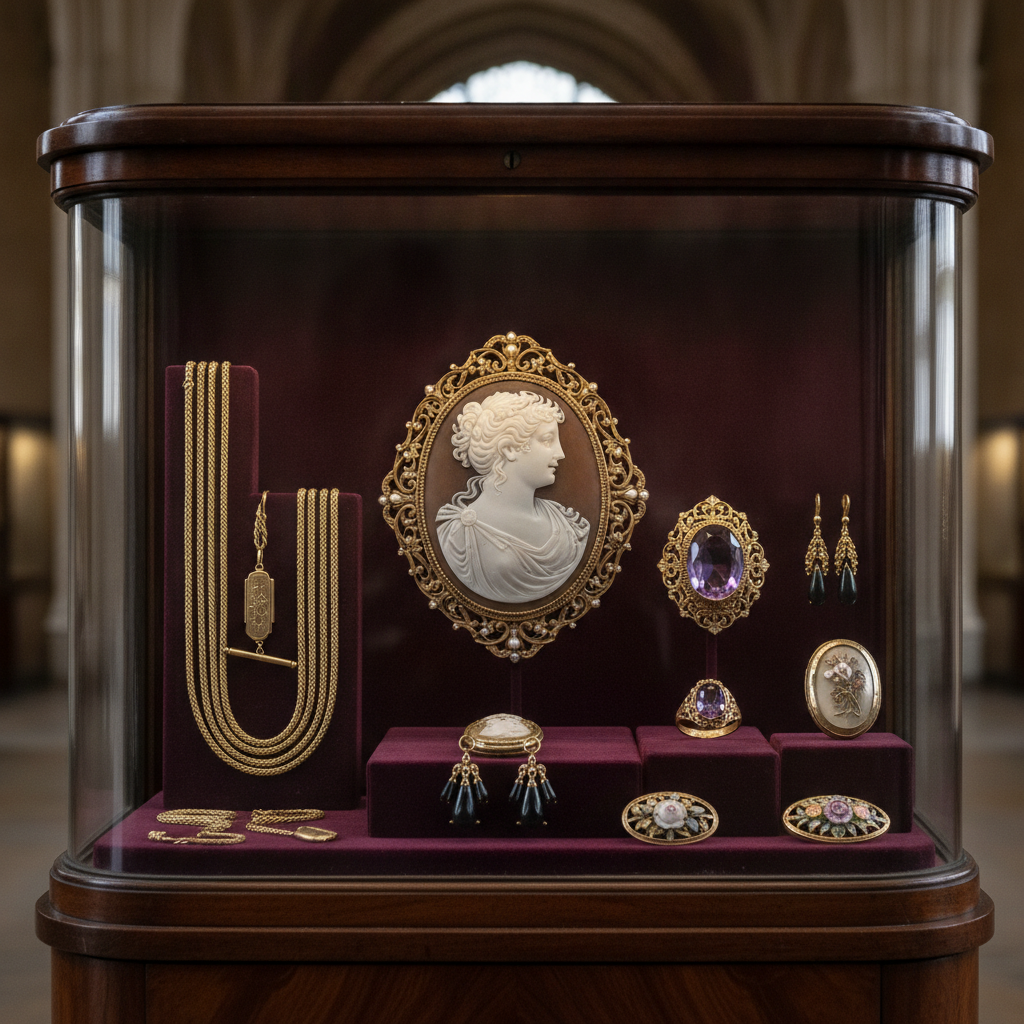
Antique jewelry identification combines detective work, historical knowledge, and gemological skill. Pieces over 100 years old carry the craftsmanship, materials, and design vocabulary of their era, but they also bear the marks of repair, modification, and sometimes deliberate deception. Whether you discovered a brooch in an attic, inherited a Victorian ring, or are evaluating an auction lot, knowing how to identify antique jewelry accurately protects you from costly mistakes. This guide covers major antique periods, identification techniques, authentication red flags, and how Jewelry Identifier: JewelValue supports your antique jewelry research.
Antique jewelry (generally defined as 100+ years old) represents a finite and non-renewable category. No more Victorian mourning brooches, Edwardian filigree pendants, or Art Nouveau enamel orchids will ever be manufactured by their original makers. This scarcity drives collector demand and makes accurate identification financially significant. A misidentified reproduction Art Deco bracelet worth $200 sold as genuine could cost a buyer $5,000. An unrecognized Georgian garnet parure worth $15,000 might be dismissed as costume jewelry worth $50.
The antique jewelry market has grown increasingly sophisticated. Reproduction pieces flood online marketplaces. Plated base metals are artificially aged to simulate patina. Modern stones are set in antique-style mountings. Synthetic gemstones available since the early 1900s appear in period-appropriate settings. Navigating this landscape requires systematic identification skills that JewelValue supplements with AI-powered visual analysis of design elements, materials, and construction characteristics visible in photographs.
Major Antique Jewelry Periods
Georgian jewelry (1714-1837) spans the reigns of George I through George IV and William IV. Genuine Georgian pieces are rare in the market because most were remounted, melted, or lost over two centuries. Characteristics include closed-back settings with foil backing enhancing gemstone color, rose-cut and table-cut diamonds, memorial and hair jewelry, and intricate cannetille gold work. Materials include high-karat gold, silver-topped gold, paste (lead glass simulating gemstones), and natural pearls. Georgian identification requires expert examination; JewelValue can flag Georgian-typical features but professional authentication is essential for pieces of potential value.
Victorian jewelry (1837-1901) is the most abundant antique category. Three sub-periods reflect changing tastes. Early Victorian (Romantic, 1837-1860) features nature motifs, serpent designs, colored gemstones, and sentimental themes. Mid-Victorian (Grand, 1860-1885) emphasizes mourning jewelry with jet, onyx, black enamel, and hair work following Prince Albert's death in 1861. Late Victorian (Aesthetic, 1885-1901) returns to lighter themes with diamonds, sapphires, turquoise, and crescent and star motifs. Victorian construction includes hand-fabrication, pinchbeck (gold simulant), low-karat gold alloys, and increasingly platinum in late pieces.
Edwardian and Belle Époque jewelry (1890-1915) overlaps late Victorian and early Art Deco. Platinum becomes the dominant fine jewelry metal, enabling delicate filigree, millegrain bead borders, and lace-like openwork designs. Garlands, bows, tassels, and floral motifs in diamonds and pearls define the aesthetic. Edwardian pieces are among the most sought-after antique jewelry for their feminine elegance and technical virtuosity. Identification focuses on platinum construction quality, millegrain detail, and diamond cutting styles transitional between Old Mine and early modern brilliant cuts.
Art Nouveau jewelry (1890-1910) rejects Victorian symmetry for organic, flowing designs inspired by nature, literature, and the female form. Master jewelers including René Lalique, Henri Vever, and Philippe Wolfers created iconic pieces in enamel, horn, glass, opal, and unconventional materials. Art Nouveau identification requires recognizing the distinctive design vocabulary: whiplash curves, insect and botanical forms, and emphasis on artistic expression over intrinsic material value. Many Art Nouveau pieces are signed, aiding authentication.
Arts and Crafts jewelry (1890-1910) parallels Art Nouveau with a different philosophy emphasizing handcraftsmanship and honest construction. Architects and designers including C.R. Ashbee and the Liberty & Co. workshop produced silver jewelry with semi-precious stones, enamel, and deliberately visible handwork. Arts and Crafts pieces reject the preciousness of Edwardian diamond jewelry in favor of design integrity and artisanal quality.
Art Deco jewelry (1920-1939) bridges antique and vintage categories depending on the specific piece date. Art Deco is defined by geometric symmetry, bold color contrast, exotic influences (Egyptian revival after Tutankhamun's tomb discovery in 1922, Asian motifs, African inspiration), calibre-cut gemstones, and platinum or white gold construction. Art Deco remains the most actively collected antique jewelry period, with strong auction markets worldwide. JewelValue recognizes many Art Deco design patterns from photographs.
Construction Techniques as Dating Clues
Construction methods provide some of the most reliable antique dating evidence because manufacturing technology evolved systematically. Hand-fabrication using sawing, filing, soldering, and hammering was the norm before widespread casting adoption. Hand-fabricated pieces show slight asymmetries, tool marks visible under magnification, and construction details that differ from machine-produced modern reproductions.
Closed-back settings with foil lining beneath gemstones characterize Georgian and early Victorian jewelry. The foil enhanced gemstone color and brilliance under candlelight and gaslight illumination. Open-back settings became standard by the late Victorian period as electric lighting reduced the need for foil enhancement. Finding a closed-back setting with intact foil strongly suggests pre-1860 construction.
Pin stem and clasp evolution helps date brooches. Early Victorian brooches have simple C-clasps without safety mechanisms. Trombone clasps (tube and pin) appear in the late Victorian and Edwardian periods. Roll-over safety clasps were introduced in the 1920s and became standard by the 1930s. Dating brooches by clasp type provides approximate age brackets that complement design analysis.
Hinge and joint construction on bracelets and bangles evolved similarly. Early pieces use simple pinned hinges. More sophisticated hinge designs with integrated safety mechanisms indicate later manufacture. Spring ring clasps on necklaces replaced hook-and-eye closures over the late 19th and early 20th centuries.
Soldering techniques reveal manufacturing era. Early hand-soldering leaves visible solder joints and sometimes excess solder blobs. Modern laser soldering creates nearly invisible joints. The transition from hand to machine production in the early 20th century changed construction character noticeably.
Gemstone cutting styles provide dating evidence. Rose cuts (flat bottom, domed faceted top) dominate Georgian and early Victorian jewelry. Old Mine cuts (cushion-shaped with rounded corners, high crown, small table) characterize mid to late Victorian pieces. Old European cuts (circular outline, higher crown than modern brilliants, open culet) appear from late Victorian through Edwardian and early Art Deco periods. Modern round brilliant cuts with precise symmetry indicate 20th-century stones, possibly recut from older material or set in reproduction mountings.
Hallmarks and Maker's Marks on Antique Jewelry
British hallmarks provide the most comprehensive dating system for antique jewelry. The assay office mark (anchor for Birmingham, leopard's head for London, castle for Edinburgh) identifies where the piece was tested. The fineness mark (crown for gold, lion passant for sterling silver) confirms metal purity. The date letter mark corresponds to a specific assay year, enabling precise dating. British hallmarks on antique jewelry can date a piece to within a single year, making them invaluable for authentication.
French hallmarks include the eagle head (18K gold, used from 1838), horse head (14K and 9K gold), and boar head (silver). Maker's marks registered with the Paris assay office identify individual jewelers. French Art Nouveau and Belle Époque pieces frequently bear maker marks alongside assay marks.
American antique jewelry lacks a mandatory national hallmark system until modern times. American pieces may bear maker's marks, karat stamps, or no marks at all. Prominent American antique jewelers including Tiffany (dating to 1837), Marcus & Co., and J.E. Caldwell used distinctive marks that specialists recognize. Absence of marks on American antique jewelry is common and does not indicate inauthenticity.
European continental marks vary by country. Austrian, German, Russian, and Dutch hallmark systems each have distinct symbols and dating conventions. Reference guides and specialist knowledge are required for non-British, non-French hallmark interpretation.
Photograph all marks clearly and submit to JewelValue for preliminary interpretation. The app recognizes common hallmark formats and connects them to likely periods and origins. Definitive hallmark authentication may require consultation with hallmark specialists and reference book comparison.
Identifying Antique Gemstones and Materials
Antique jewelry gemstones differ from modern equivalents in cutting style, treatment history, and available species. Old-cut diamonds were cut to maximize weight retention rather than optical performance, resulting in different proportions than modern stones. These antique cuts are valued for their character and period authenticity; recutting into modern brilliants destroys historical value.
Synthetic gemstones have existed since the early 1900s. Verneuil flame-fusion rubies and sapphires (since 1902), synthetic spinel, and later synthetic emeralds appear in antique and vintage jewelry. Synthetic stones in period-appropriate mountings are themselves collectible as examples of early synthetic gem production. Identification requires gemological testing beyond visual examination.
Common antique jewelry gemstones include garnets (almandine and pyrope, frequently rose-cut), amethyst, turquoise (often matrix-bearing), coral, seed pearls, opals, moonstones, and chrysoberyl (including cat's eye and alexandrite). Diamond and sapphire appear in finer antique pieces. Material identification through JewelValue provides preliminary species suggestions based on visual characteristics visible in photographs.
Jet, vulcanite, and bog oak served as mourning jewelry materials in Victorian England. These organic materials require different care than mineral gemstones and have distinct identification characteristics. Jet is fossilized wood (hard, lightweight, warm to touch). Vulcanite is hardened rubber (slightly flexible, sulfur smell when rubbed). Bog oak is fossilized oak wood (lightweight, dark brown to black).
Hair jewelry incorporating human hair in elaborate woven patterns was fashionable Victorian mourning and sentimental jewelry. Authentication examines weaving technique, mounting style, and hair color consistency. Hair jewelry has niche collector value distinct from standard gemstone jewelry appraisal.
Enamel work in antique jewelry ranges from champlevé and cloisonné to plique-à-jour (translucent enamel without metal backing, characteristic of Art Nouveau). Enamel condition significantly affects value. Chips, cracks, and repairs are common in antique enamel and are documented during identification and appraisal.
Red Flags: Reproductions and Fakes
Reproduction antique jewelry is legal when sold as reproduction but fraudulent when misrepresented as genuine. Common reproduction categories include Art Deco-style bracelets and brooches, Victorian mourning jewelry, and Edwardian filigree rings. Reproduction indicators include machine-perfect symmetry, modern cut stones in "antique" settings, casting seams in areas that should be hand-fabricated, and artificial patination that appears uniform rather than naturally aged.
Marriage pieces combine antique and modern components: a genuine Victorian brooch pin stem attached to a modern reproduction top, or antique stones reset in newly made mountings. These hybrid pieces have legitimate value but less than unmodified antiques. Examine junction points between components for evidence of later modification.
Gold plating on base metal with artificial aging is common in fake antique jewelry sold online. Test wear points for base metal showing through. Genuine antique gold maintains consistent composition; plating reveals different metal beneath at wear points.
Too-perfect condition raises suspicion for purported antique jewelry. Genuine pieces over 100 years old typically show some wear: gentle thinning of ring shanks, softened engraving details, minor surface scratches, and clasp wear. Pristine "antique" pieces may be reproductions or have been extensively restored.
Provenance claims without documentation should be verified independently. "Estate fresh" and "attic find" narratives are standard sales language regardless of actual origin. Judge the piece on physical evidence rather than seller stories.
JewelValue analyzes design elements, construction visible in photographs, and material characteristics to flag when a piece's features are inconsistent with claimed age or period. Use the app as an independent check before purchasing antique jewelry at significant prices.
Using JewelValue for Antique Jewelry Identification
Photograph antique jewelry under natural daylight, capturing the overall piece, individual design details, hallmarks, clasp mechanisms, and gemstone characteristics. Include the back of pieces where construction details and marks are often visible.
Submit images to Jewelry Identifier: JewelValue for analysis. The app evaluates design vocabulary against period databases, suggests likely era and style, identifies visible gemstones and metals, and provides educational context about the period characteristics it detected.
Use JewelValue results to guide further research. If the app suggests Art Deco with calibre-cut onyx and platinum construction, search auction databases for comparable sold pieces to estimate value range. If it identifies Victorian mourning jewelry characteristics, research the mourning jewelry collector market.
JewelValue does not replace expert physical examination for high-value antique purchases. Consult antique jewelry specialists, certified appraisers with period expertise, and gemological laboratories for definitive authentication when financial stakes justify the investment. The app excels at education, preliminary sorting, and providing independent analysis that complements expert evaluation.
Save identifications in your JewelValue collection to build a documented catalog of your antique jewelry with photographs and AI analysis timestamps.
Caring for Antique Jewelry
Antique jewelry requires gentler handling than contemporary pieces. Avoid ultrasonic cleaners, which can loosen old solder joints, damage enamel, and threaten foil-backed settings. Clean with soft dry brushes and barely damp cloths. Professional cleaning by conservators experienced with antique jewelry is recommended for valuable pieces.
Store antique jewelry in individual soft pouches or compartmentalized boxes. Separate pieces to prevent harder stones from scratching softer materials. Keep away from direct sunlight, which fades some gemstones and degrades organic materials like jet, coral, and pearls.
Wear antique jewelry with awareness of its age and fragility. Edwardian filigree and enamel work is delicate. Georgian foil-backed stones should never be submerged in water. Victorian hair jewelry is extremely fragile. Enjoy antique pieces for special occasions rather than daily wear when preservation is a priority.
Insure significant antique jewelry with scheduled riders backed by professional appraisal from specialists in period jewelry. JewelValue preliminary identification helps determine which pieces justify insurance appraisal costs.
Frequently Asked Questions
How old does jewelry need to be to qualify as antique?
The standard definition is 100 years or older. In 2026, jewelry from 1926 or earlier qualifies as antique. Pieces from the 1920s and 1930s occupy a transitional zone between antique and vintage depending on the specific date. Some dealers and collectors use "antique" more loosely to mean any old piece, but the 100-year threshold is the accepted standard in appraisal and auction contexts. JewelValue identifies period design elements that indicate approximate age.
Can JewelValue identify the exact age of antique jewelry?
JewelValue identifies period-typical design elements, construction characteristics, and materials visible in photographs, suggesting the most likely era (Georgian, Victorian, Edwardian, Art Nouveau, Art Deco). Precise dating requires physical examination of hallmarks, construction details, and gemological testing. British hallmarks with date letters can date pieces to a specific year. The app provides approximate period attribution that guides further expert evaluation.
How do I know if antique jewelry is real or a reproduction?
Examine construction for hand-fabrication evidence versus machine production. Check clasp and hinge types against period-appropriate designs. Evaluate gemstone cutting styles for period consistency. Test metal wear points for plating versus solid material. Assess overall condition relative to claimed age. Compare with JewelValue period analysis. For significant purchases, obtain expert authentication from antique jewelry specialists before buying.
Is antique jewelry a good investment?
Fine antique jewelry with genuine materials, period authenticity, and good condition has historically held or appreciated in value, particularly Art Deco, Edwardian, and signed designer pieces. However, antique jewelry should be purchased primarily for appreciation of its beauty, history, and craftsmanship rather than as a financial investment. Market values fluctuate with fashion cycles and economic conditions. Buy what you love and can afford, using JewelValue and professional appraisal to ensure you pay appropriate prices.
Where can I sell antique jewelry?
Selling channels depend on piece quality and value. Exceptional pieces sell through major auction houses (Christie's, Sotheby's, Heritage) or specialized antique jewelry dealers. Mid-range antique jewelry sells through regional auction houses, antique fairs, and curated online platforms. Use JewelValue to understand your piece's period and materials before choosing a sales channel, and obtain professional appraisal for high-value items to set realistic price expectations.
Download Jewelry Identifier: JewelValue Today
Antique jewelry tells stories spanning centuries. Jewelry Identifier: JewelValue helps you read those stories by identifying period styles, gemstones, metals, and construction characteristics from photographs of your antique treasures.
Download Jewelry Identifier: JewelValue on the App Store and begin identifying your antique jewelry today.