Diamond engagement rings represent one of the most significant jewelry purchases most people will ever make. Understanding how to evaluate, identify, and value these rings protects you whether you are shopping for a new ring, assessing an inherited piece, or verifying an online listing. This comprehensive guide covers diamond quality factors, popular setting styles, metal choices, and how Jewelry Identifier: JewelValue helps you identify and evaluate engagement rings from photographs with confidence.
The global engagement ring market encompasses an enormous range of quality and price. A solitaire ring might feature a half-carat diamond in 14-karat gold for under $2,000, while a three-carat D-flawless diamond in a platinum halo setting commands six figures. This vast range makes education essential. Without understanding the Four Cs (cut, color, clarity, and carat weight) and how setting choices affect appearance and durability, buyers routinely overpay for mediocre stones or underestimate the value of exceptional ones.
Engagement ring identification extends beyond the center diamond. The metal type, setting construction, accent stones, brand provenance, and overall condition all contribute to total value. Inherited rings often arrive without documentation, leaving families to wonder whether grandmother's ring contains a valuable diamond or a convincing simulant. JewelValue provides immediate preliminary answers that guide further evaluation and help families make informed decisions about insurance, retention, and sale.
Understanding the Four Cs of Diamond Quality
Cut is widely considered the most important of the Four Cs because it most directly affects a diamond's beauty. Cut refers not to the diamond's shape (round, princess, oval) but to how precisely the facets are proportioned and aligned. An excellently cut diamond reflects light internally and returns it through the crown, creating the brilliance, fire, and scintillation that make diamonds captivating. Poorly cut diamonds leak light through the bottom and sides, appearing dull regardless of color or clarity grade.
The GIA cut grading scale for round brilliant diamonds ranges from Excellent to Poor. Diamonds graded Excellent or Very Good deliver outstanding light performance. Good cuts offer acceptable beauty at lower prices. Fair and Poor cuts should generally be avoided regardless of other grades, as they sacrifice the optical properties that justify diamond pricing. Fancy shapes (princess, cushion, oval, emerald, pear, marquise) lack standardized cut grades but should still exhibit balanced proportions and pleasing symmetry.
Color grading evaluates how colorless a diamond appears. The GIA scale runs from D (completely colorless) through Z (light yellow or brown). Most engagement ring diamonds fall in the D through J range, with D-F considered colorless, G-J near-colorless, and K-M faint yellow. Color differences become subtle above G in mounted stones, especially in yellow or rose gold settings that cast warm tones onto the diamond. Platinum and white gold settings showcase colorlessness more prominently.
Clarity grading assesses internal characteristics (inclusions) and surface blemishes. The GIA scale includes Flawless (no inclusions or blemishes visible under 10x magnification), Internally Flawless, VVS1-VVS2 (very very slightly included), VS1-VS2 (very slightly included), SI1-SI2 (slightly included), and I1-I3 (included). Most engagement rings feature VS2 through SI1 clarity grades, where inclusions are invisible to the naked eye but present under magnification. The goal is eye-clean appearance, not necessarily the highest clarity grade.
Carat weight measures diamond size, with one carat equaling 200 milligrams. Carat weight disproportionately affects price because larger diamonds are rarer. A two-carat diamond costs far more than twice a one-carat diamond of equivalent quality. However, carat weight alone does not determine visual size. A well-cut one-carat diamond can appear larger than a poorly cut 1.2-carat stone because proper proportions maximize face-up diameter. JewelValue estimates carat weight ranges from photographs when the stone is clearly visible, helping you contextualize value before professional measurement.
Popular Engagement Ring Settings and Styles
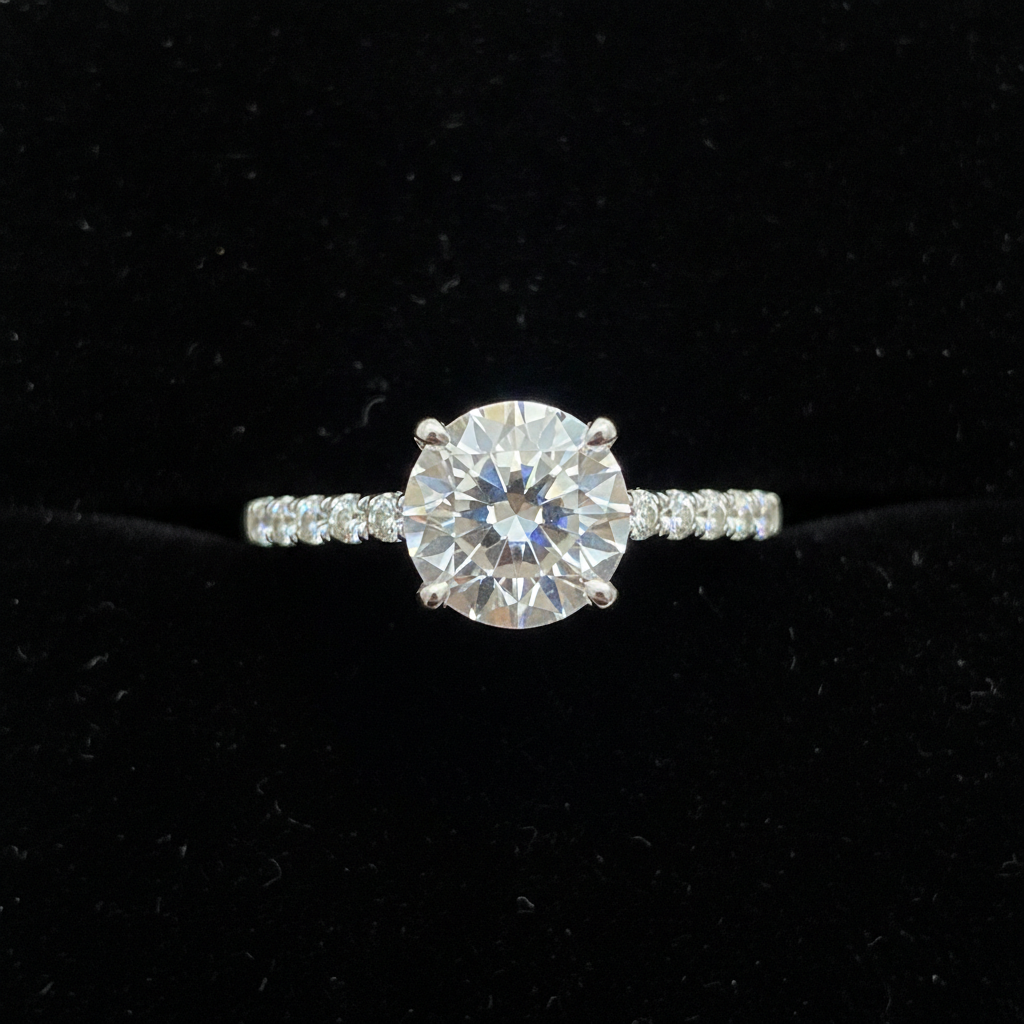
The solitaire setting remains the most popular engagement ring style, featuring a single center diamond in a simple mounting that showcases the stone without distraction. Prong settings (typically four or six prongs) hold the diamond with minimal metal contact, maximizing light entry. Bezel settings surround the diamond with a metal rim, offering superior protection for active lifestyles at the cost of slightly reduced brilliance. Tension settings hold the diamond between two metal ends without visible prongs, creating a modern floating appearance.
Halo settings surround the center diamond with a circle of smaller accent diamonds, making the center stone appear larger and adding total sparkle. Double halos add a second row of accent stones for maximum visual impact. Halo settings have dominated engagement ring trends for over a decade and remain among the most requested styles. When identifying halo rings with JewelValue, both the center stone and accent stones are analyzed for species and quality indicators.
Three-stone settings feature a center diamond flanked by two side stones representing past, present, and future. Side stones may be diamonds or colored gemstones. The total visual impact depends on how well all three stones complement each other in color and proportions. Vintage and antique three-stone rings often feature Old European or Old Mine cut diamonds with different optical character than modern round brilliants.
Pavé bands incorporate small diamonds set closely together along the band, creating a continuous sparkle surface. Micro-pavé uses extremely small diamonds (often 1-1.5mm) set with minimal visible metal. Pavé settings add significant cost and require periodic maintenance as small stones can loosen over time. Channel settings hold diamonds in a groove between two metal walls, offering a sleek appearance with better stone security than pavé.
Cathedral settings raise the center stone on arches of metal that rise from the band, creating an elegant elevated profile. This style provides excellent stone visibility and allows wedding bands to sit flush against the engagement ring. Vintage-inspired settings draw from Art Deco, Edwardian, and Victorian design vocabularies, featuring milgrain detailing, filigree work, and mixed metal accents that JewelValue can often identify by period style.
Choosing the Right Metal for Your Engagement Ring
Platinum is the premium choice for engagement rings, offering exceptional durability, natural white color that never fades, and hypoallergenic properties. Platinum's density makes it feel substantial on the hand. It develops a natural patina over time that many owners appreciate for its vintage character, and it can be repolished to restore original luster. The primary drawback is cost: platinum rings typically cost 30-50% more than equivalent gold settings.
White gold provides a similar white appearance at lower cost. Most white gold is rhodium-plated to achieve a bright white finish, as the underlying alloy has a slight yellow tint. Rhodium plating wears over time (typically one to three years depending on wear), revealing the warmer tone beneath and requiring replating. 14-karat white gold offers good durability; 18-karat white gold is softer but richer in gold content.
Yellow gold delivers timeless warmth and complements diamonds with faint color grades (I, J, K) by making them appear whiter in contrast. 14-karat yellow gold balances durability and gold content for daily wear. 18-karat yellow gold offers richer color but scratches more easily. Rose gold has surged in popularity for its romantic, vintage-inspired warmth and flattering tone on many skin colors. Like yellow gold, rose gold masks faint diamond color effectively.
When identifying engagement ring metals with JewelValue, photograph any hallmarks visible inside the band. Stamps like "PT950," "PLAT," "14K," "18K," "585," and "750" provide definitive metal identification clues. Without visible stamps, the app analyzes surface color, luster, and wear patterns to suggest the most likely metal type.
How to Identify a Diamond Engagement Ring
Identifying whether an engagement ring contains a genuine diamond versus a simulant is one of the most common jewelry identification tasks. Common diamond simulants include cubic zirconia (CZ), moissanite, white sapphire, and white topaz. Each has visual characteristics that distinguish it from diamond when you know what to look for and when AI tools like JewelValue analyze high-quality photographs.
Diamonds exhibit strong light dispersion (fire), returning white light (brilliance) and colored light flashes (fire) in balanced proportion. Moissanite shows even more fire than diamond, with rainbow flashes that experienced observers describe as excessive. Cubic zirconia appears overly brilliant with less nuanced fire, and its lower hardness (8.5 versus diamond's 10) means edges soften with wear over time. White sapphire looks glassy compared to diamond, with less brilliance and virtually no fire.
Thermal conductivity testers (diamond testers) distinguish diamond from most simulants by measuring how quickly the stone conducts heat. Diamond and moissanite both test positive on standard diamond testers, so moissanite-specific testers or electrical conductivity tests are needed to separate those two. JewelValue analyzes optical characteristics visible in photographs, providing a non-destructive first assessment without specialized testing equipment.
Examine the setting for clues about the center stone's identity. Fine diamonds are typically set in platinum, 18-karat gold, or high-quality 14-karat gold. A "D color, VVS1" stone in a gold-plated brass setting is a contradiction that suggests simulant. Prong quality, gallery construction, and overall craftsmanship provide context for whether the center stone is likely genuine.
For inherited rings without documentation, JewelValue provides invaluable preliminary identification. Photograph the ring from multiple angles under natural daylight and review the app's analysis of the center stone, accent stones, and metal type. If the app identifies a likely genuine diamond with estimated quality range, scheduling a professional appraisal and GIA report is clearly justified. If it suggests simulant, you save the cost of unnecessary professional evaluation.
Diamond Engagement Ring Pricing and Value Factors
Diamond engagement ring pricing follows a complex interplay of the Four Cs, market conditions, brand premium, and setting complexity. At the wholesale level, diamond prices are tracked by Rapaport and IDEX industry price lists that update regularly based on supply and demand. Retail prices add markup for design, labor, brand name, and business overhead.
Brand premium significantly affects price. Tiffany, Cartier, Harry Winston, and similar houses command premiums of 50-200% or more over equivalent unbranded rings because of design heritage, perceived prestige, and retail experience. When evaluating branded engagement rings, the brand itself is a value component separate from raw materials. JewelValue helps identify designer and period styles that may carry brand premiums.
Lab-grown diamonds have transformed the engagement ring market since 2018. Chemically and optically identical to mined diamonds, lab-grown stones typically cost 60-80% less than natural diamonds of equivalent quality. Identification requires specialized equipment because lab-grown and natural diamonds are visually indistinguishable. GIA and IGI now grade lab-grown diamonds with distinct report formats. JewelValue may flag when lab-grown origin is possible and recommend laboratory verification for high-value stones.
Secondary market values for engagement rings are substantially lower than retail replacement values. A ring purchased for $8,000 at retail might achieve $3,000-4,000 on the secondary market through consignment or private sale. Pawn and dealer buyout offers are lower still. Understanding this gap prevents disappointment when selling and informs insurance decisions about replacement versus actual cash value coverage.
JewelValue's value estimation feature provides market-context ranges for engagement rings based on identified materials and apparent quality. These estimates help buyers negotiate, sellers price competitively, and owners decide whether formal appraisal is worthwhile for insurance scheduling.
Caring for Your Diamond Engagement Ring
Daily wear exposes engagement rings to oils, lotions, soap residue, and environmental grime that accumulate under prongs and dull diamond brilliance. Clean your ring weekly by soaking in warm water with mild dish soap, gently brushing with a soft toothbrush, and rinsing thoroughly. Professional ultrasonic cleaning twice yearly removes buildup that home cleaning misses, but avoid ultrasonics for fracture-filled diamonds or stones with significant clarity characteristics that could worsen under vibration.
Insure your engagement ring through a scheduled personal property rider on your homeowners or renters policy, backed by a professional appraisal updated every two to three years. Standard policy jewelry limits are inadequate for most engagement rings. Document your ring with JewelValue photographs and identifications as supplementary evidence for insurance claims.
Remove your ring during activities that risk impact or chemical exposure: gym workouts, gardening, cleaning with harsh chemicals, swimming in chlorinated pools, and cooking with abrasive ingredients. Platinum and gold are durable but not indestructible. Prongs bend, bands wear thin, and diamonds chip when struck against hard surfaces at the wrong angle.
Schedule annual inspections with a jeweler who checks prong tightness, band integrity, and stone security. Retipping worn prongs costs far less than replacing a lost center diamond. Many jewelers offer complimentary inspection for rings purchased from their store; independent jewelers typically charge modest inspection fees.
Store your ring safely when not wearing it. A dedicated ring dish by the sink prevents accidental loss down the drain. For travel, use a ring case rather than tossing it loose in a luggage pocket. At home, a ring box or jewelry armoire compartment protects against scratches from other jewelry.
Frequently Asked Questions
How can I tell if my engagement ring diamond is real?
Start by photographing the ring with JewelValue for AI-powered preliminary identification based on optical characteristics. Look for signs of wear on the stone: cubic zirconia edges soften over time while diamond maintains crisp facet lines. Check the setting quality: genuine diamonds in fine settings versus simulants in cheap mountings. For definitive verification, use a diamond tester (thermal conductivity) and, for high-value stones, obtain a GIA or IGI laboratory report. Moissanite requires additional electrical conductivity testing because it also tests positive on standard diamond testers.
What is the most popular engagement ring style in 2026?
Solitaire and halo settings remain the most popular engagement ring styles, with oval and elongated cushion cut diamonds continuing the trend toward elongated shapes that appear larger on the hand. Rose gold and mixed-metal designs maintain strong demand. Vintage-inspired settings with milgrain and filigree details appeal to buyers seeking unique character. Three-stone rings have resurged in popularity following celebrity engagement announcements. JewelValue identifies all these styles from photographs, helping buyers and sellers communicate accurately about ring design.
How much should I spend on an engagement ring?
Spend what fits your financial situation without going into debt. The outdated "two months' salary" guideline has no practical basis. Focus on maximizing quality within your budget: a well-cut 0.75-carat diamond in a quality setting outperforms a poorly cut 1.5-carat stone visually and financially. Use JewelValue to verify that listed specifications match visual evidence when shopping, ensuring your budget delivers genuine value rather than inflated claims.
Does JewelValue work for lab-grown diamond engagement rings?
JewelValue identifies that a stone is diamond based on visual characteristics but cannot distinguish lab-grown from natural origin through photography alone. Both are chemically identical diamond. If lab-grown versus natural origin matters for your purchase or valuation, request a GIA or IGI laboratory report that explicitly states growth origin. The app will recommend laboratory verification when diamond identification is confirmed and value stakes are significant.
Should I get my engagement ring appraised?
Yes, if the ring's value exceeds your homeowners policy jewelry limit (typically $1,500-2,500). A professional appraisal enables insurance scheduling that covers full replacement value after loss or theft. Use JewelValue first to confirm the ring's materials and estimated value range, then schedule professional appraisal for rings where insurance coverage is clearly justified. Update appraisals every two to three years to reflect market changes.
Download Jewelry Identifier: JewelValue Today
Whether you are shopping for the perfect engagement ring, evaluating an inherited family treasure, or selling a pre-owned ring, Jewelry Identifier: JewelValue gives you instant diamond and setting identification from a simple photograph.
Download Jewelry Identifier: JewelValue on the App Store and identify your engagement ring with confidence today.