
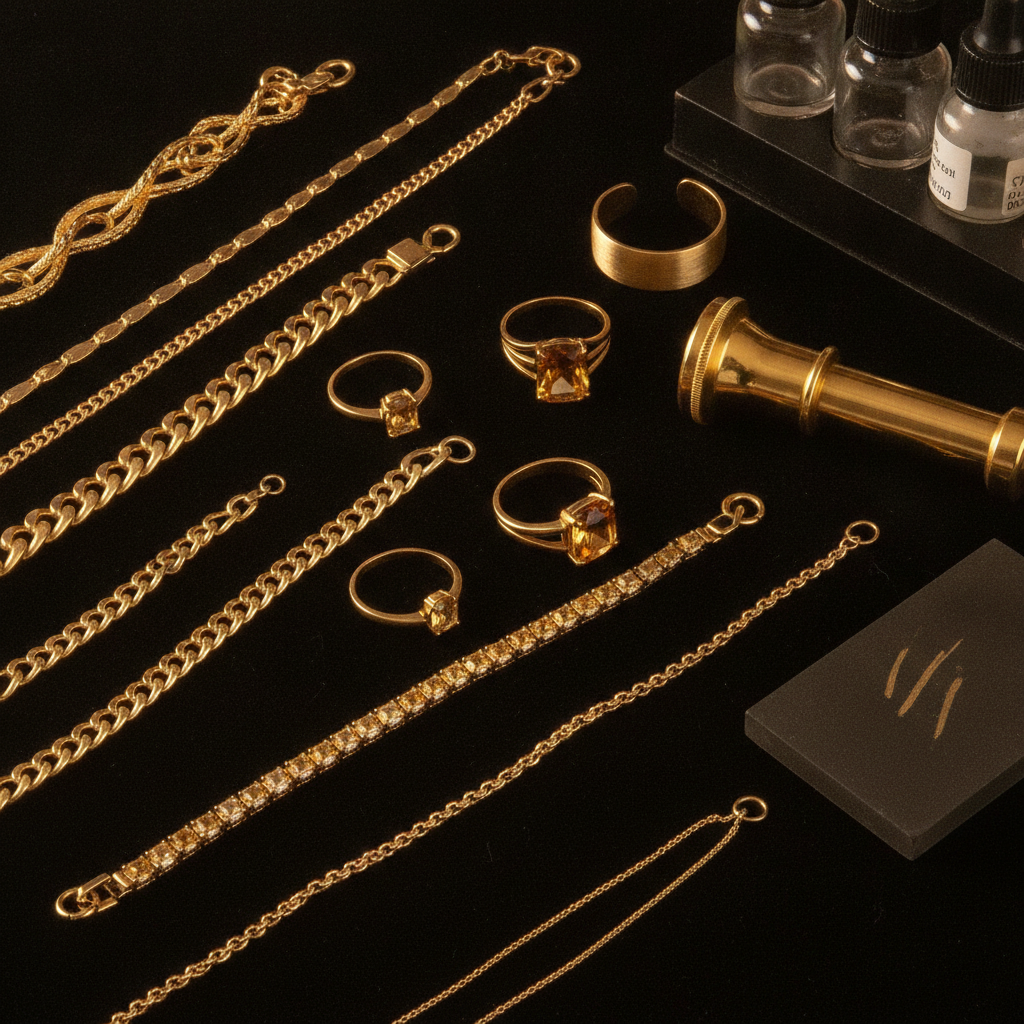
Gold jewelry identification is one of the most practically important skills in the jewelry world. Gold's enduring value makes it a target for counterfeiting, misrepresentation, and honest confusion. Is grandmother's chain solid 14-karat gold or gold-plated brass? Does that estate sale ring contain genuine gold or a convincing imitation? Understanding how to identify gold jewelry protects you from overpaying, underselling, and making insurance decisions based on wrong assumptions. This guide covers gold purity standards, hallmark identification, testing methods, and how Jewelry Identifier: JewelValue analyzes gold jewelry from photographs.
Gold has captivated humanity for over 6,000 years of jewelry making. Its resistance to tarnish, warm luster, malleability, and rarity established it as the premier precious metal for fine jewelry across virtually every culture. Today, gold jewelry represents a significant portion of personal wealth for many households, whether in wedding bands, chains, bracelets, or coin collections. Accurate identification determines whether a drawer full of jewelry is worth hundreds or tens of thousands of dollars.
The gold jewelry market includes solid gold (uniform gold alloy throughout), gold-filled (thick gold layer bonded to base metal core), gold-plated (thin gold electroplate over base metal), and gold-vermeil (gold plate over sterling silver). Each category has legitimate market roles at different price points. Problems arise when plated pieces are sold as solid gold, or when owners assume all yellow metal jewelry is valuable gold. JewelValue helps clarify these distinctions from photographs before you invest in professional testing or make financial decisions.
Understanding Gold Purity and Karat Marks
Gold purity is measured in karats (not to be confused with carats, which measure gemstone weight). Pure gold is 24 karat (24K), meaning 24 out of 24 parts are gold. Pure gold is too soft for most jewelry applications, so it is alloyed with other metals for durability. Common jewelry alloys include 22K (91.7% gold, popular in Middle Eastern and Indian jewelry), 18K (75% gold, standard for fine European jewelry), 14K (58.3% gold, the American standard for fine jewelry), and 10K (41.7% gold, the legal minimum to call a piece "gold" in the United States).
International hallmark systems use fineness numbers instead of karats. 750 equals 18K (75.0% gold). 585 equals 14K (58.5% gold). 417 equals 10K (41.7% gold). 916 or 917 equals 22K. European, Asian, and many American pieces display these numbers. Knowing both karat and fineness systems helps you interpret marks on jewelry from any origin.
Color variations result from alloying metals. Yellow gold alloys with silver and copper in various proportions. White gold alloys with palladium, nickel, or silver, then is often rhodium-plated for bright white appearance. Rose gold alloys with higher copper content. Green gold uses silver and copper in specific ratios. All are genuine gold if they meet minimum purity standards for their karat mark, regardless of color.
Gold-filled jewelry contains a substantially thicker gold layer than plating, typically 5% of total weight in 14K gold mechanically bonded to a brass core. Marked "1/20 14K GF" or similar, gold-filled pieces offer gold appearance and durability at lower cost than solid gold. Gold-filled jewelry has genuine gold content worth recovering by refiners, unlike thin-plated pieces.
Gold-plated jewelry has an extremely thin gold layer applied by electroplating, often less than 0.5 microns thick. Marked "GP," "GEP," "HGE" (heavy gold electroplate), or "gold plated," these pieces contain minimal gold content. The base metal is typically brass, copper, or pot metal. Plating wears through with use, revealing the base metal beneath, particularly on ring shanks, chain links, and clasp contact points.
Reading Gold Hallmarks and Stamps
Hallmark examination is the first step in gold jewelry identification. Common locations for stamps include the inside of ring bands, clasp mechanisms on necklaces and bracelets, earring posts and backs, and the back of pendants and brooches. Use a jeweler's loupe (10x magnification) or your phone's macro mode to read small stamps clearly.
Solid gold stamps include: "24K" or "999" (pure gold), "22K" or "916," "18K" or "750," "14K" or "585," and "10K" or "417." Country-specific marks add information: British hallmarks include assay office symbols, fineness marks, and date letters in a stamped set. Italian gold is marked "750" for 18K with numeric maker identification. French marks include eagle heads (18K) and horse heads (14K and 9K).
Non-solid gold stamps to recognize: "GF" or "G.F." (gold-filled), "GP" or "G.P." (gold-plated), "GEP" (gold electroplate), "RGP" (rolled gold plate), "HGE" or "H.G.E." (heavy gold electroplate), "1/20 14K" (gold-filled indicating 1/20th of total weight is 14K gold). "Vermeil" indicates gold plate over sterling silver base. Absence of any gold stamp does not mean a piece is not gold, but unstamped pieces require physical testing for confirmation.
Maker's marks and designer signatures sometimes accompany purity stamps. Tiffany, Cartier, and other major houses stamp their name alongside fineness marks. These brand marks add value beyond gold content but also attract counterfeiters who stamp fake designer names on plated pieces.
Photograph hallmarks clearly and submit to JewelValue for analysis. The app recognizes standard stamp formats and interprets their meaning, providing immediate context about likely gold content while noting when physical verification is recommended.
Visual Identification of Gold Jewelry
Visual examination provides preliminary gold identification clues before testing. Color alone is unreliable because gold-plated pieces mimic gold color when new, and various gold alloys display different yellow tones. However, color combined with other visual factors builds a useful assessment.
Examine wear patterns closely. Gold plating wears thin on high-contact areas: the bottom of ring shanks, chain link edges, clasp mechanisms, and earring post threads. When plating wears through, you see a different color metal beneath, typically brassy yellow or silvery gray. Solid gold maintains uniform color through wear, though it develops scratches and patina. This wear-through test is one of the most reliable visual indicators of plating versus solid gold.
Surface texture differences distinguish gold from common base metals. Gold's malleability means it dents rather than chips when struck. Plated base metals may show flaking, chipping, or peeling where the plate separates from the substrate. Green or black discoloration on skin after wearing suggests base metal reaction, not genuine gold, which is hypoallergenic and tarnish-resistant.
Magnet testing provides a quick screening tool. Gold is not magnetic. If a strong neodymium magnet attracts your jewelry, it contains ferromagnetic base metal and is not solid gold. However, non-magnetic base metals (brass, copper, some stainless steels) pass the magnet test, so magnetic attraction confirms non-gold but non-attraction does not confirm gold.
Weight relative to size offers clues. Gold is dense (19.3 g/cm³). A gold ring feels noticeably heavier than a similarly sized plated ring with a base metal core. Experienced gold buyers develop intuition for expected weight by size, but this skill requires calibration against known pieces.
JewelValue analyzes gold jewelry photographs for color consistency, surface characteristics, hallmark visibility, and construction quality. The app suggests likely gold content and purity while explaining the visual evidence supporting its assessment.
Physical Testing Methods for Gold
The acid scratch test is the traditional field method for gold identification. Rub the piece on a testing stone to leave a metal streak, then apply nitric acid solutions of known concentration to the streak. Pure gold resists all acid. 18K gold resists up to 18K acid but dissolves in lower-karat acid. 14K resists 14K acid, and so on. Gold-plated pieces show base metal color beneath the dissolved gold streak. This test requires training, proper safety equipment, and practice. It leaves a small scratch on the piece.
Electronic gold testers measure electrical conductivity to estimate karat purity non-destructively. They are more expensive than acid test kits ($200-500) but do not damage jewelry. Accuracy varies with surface condition, plating, and alloy composition. They work best on flat, clean surfaces and may give misleading results on plated pieces (reading the plate, not the base metal).
X-ray fluorescence (XRF) analyzers provide the most accurate non-destructive gold testing. These benchtop or handheld instruments bombard the metal with X-rays and analyze the emitted fluorescence spectrum to determine exact metal composition. Professional jewelers, pawn shops, and refiners use XRF daily. The test reads surface composition, so very thick gold plating can still mislead XRF, but it reliably identifies solid gold purity.
Fire assay is the destructive definitive test used by refiners. A sample is melted with flux, separating gold from other metals by weight. This is the reference method for gold purity determination but destroys the sample, making it inappropriate for jewelry evaluation. Refiners use fire assay when purchasing scrap gold lots.
For most owners and buyers, the practical testing workflow combines hallmark examination, visual wear assessment, magnet testing, and JewelValue photographic analysis as non-destructive first steps, followed by electronic testing or acid testing at a jeweler or pawn shop when results justify confirmation.
Common Gold Jewelry Types and Identification Tips
Gold chains are among the most commonly tested jewelry items. Solid gold chains feel uniformly heavy, show consistent color throughout including link edges, and bear hallmark stamps on the clasp. Hollow gold chains are genuine gold but weigh less than solid chains of the same outer dimensions. Gold-plated chains feel light, show wear on link edges, and may have stamps indicating plate ("GP") or no stamps at all.
Gold rings present identification opportunities on the inside of the band where hallmarks are stamped and wear is visible on the shank bottom. Wedding bands worn daily for decades show gold's characteristic gradual thinning without color change. Plated rings reveal base metal at the shank bottom within months of daily wear.
Gold earrings are tested at the post and back where stamps appear and wear occurs. Gold-filled earring hooks are common in mid-range jewelry. Stud earrings with genuine gold settings but CZ stones are frequently misidentified as "gold and diamond" when only the setting is gold.
Gold bracelets follow the same identification principles as chains and rings. Tennis bracelets and charm bracelets require checking both metal hallmarks and individual component metals, as charms may be different purities or materials than the chain.
Gold coins and bullion jewelry require specialized knowledge. Karat gold coins (like American Eagle gold coins at 22K) differ from 24K bullion bars. Gold coin jewelry that has been modified into pendants may have altered purity at drill points. JewelValue helps identify gold jewelry types and suggests when specialist numismatic or bullion evaluation is appropriate.
Gold Jewelry Value and Market Context
Gold jewelry value has two components: intrinsic gold melt value and craftsmanship or brand premium. Melt value is calculated from the piece's gold weight multiplied by the gold purity percentage multiplied by the current spot gold price per troy ounce. A 14K gold chain weighing 10 grams contains approximately 5.83 grams of pure gold (58.3% of 10g). At a $2,000/troy ounce spot price, that pure gold content is worth roughly $375 at melt.
Fine jewelry commands premiums above melt value when design, brand, gemstone content, or antique character add value. A Tiffany 18K gold bracelet is worth far more than its gold weight because of brand and design. A simple gold wedding band trades near melt value. An antique gold mourning locket has collector value beyond its gold content. JewelValue estimates total jewelry value considering both material and design factors.
Selling gold jewelry channels include: jewelry stores (trade-in toward new purchases), pawn shops (quick cash at below-market prices), gold buyers and refiners (melt value minus processing fee), consignment shops (retail resale for fine pieces), and private sale (maximum return but requires buyer identification). Understanding your gold's purity and weight before selling prevents accepting lowball offers based on misidentified purity.
Gold prices fluctuate daily based on global commodity markets. Insurance appraisals for gold jewelry use replacement value (retail cost to replace the piece), which exceeds melt value. Keeping gold jewelry identification and appraisal current ensures adequate insurance coverage as gold prices change.
Protecting Yourself When Buying Gold Jewelry
When purchasing gold jewelry, verify hallmarks match seller claims. A piece described as "18-karat gold" should bear "18K" or "750" stamps. Request weight in grams and calculate approximate melt value to assess whether the asking price is reasonable relative to gold content plus reasonable craftsmanship markup.
Beware of underkarating, where jewelry stamped 14K contains less gold than the mark indicates. This is more common in imported jewelry from unregulated markets. Independent testing at a jeweler before purchase protects against underkarating fraud.
Gold-plated jewelry sold without clear disclosure is a persistent marketplace problem. Online listings may describe "gold tone" or "gold color" pieces ambiguously. JewelValue identification before purchase clarifies what you are actually buying.
For investment purposes, gold bullion coins and bars are more efficient than gold jewelry because they trade closer to spot price without craftsmanship markup. Gold jewelry is primarily a wearable asset with gold content providing a value floor, not a pure investment vehicle.
Frequently Asked Questions
How can I tell if jewelry is real gold without testing?
Look for karat hallmarks (14K, 18K, 750, 585) stamped on the piece. Examine high-wear areas for color consistency: solid gold maintains uniform color while plating reveals different metal beneath. Gold is not magnetic. Genuine gold feels dense and heavy for its size. JewelValue analyzes photographs for hallmark stamps, color consistency, and construction clues to suggest whether jewelry is likely solid gold, gold-filled, or plated.
What does 585 mean on jewelry?
585 is the international fineness mark for 14-karat gold, indicating the piece is 58.5% pure gold alloyed with other metals for durability. It is equivalent to the "14K" stamp used in the United States. Other common fineness marks include 750 (18K), 417 (10K), and 916 (22K). JewelValue recognizes international hallmark systems and explains their meaning when you photograph jewelry stamps.
Is gold-plated jewelry worth anything?
Gold-plated jewelry has minimal intrinsic value because the gold layer is extremely thin, typically less than 0.5 microns. The underlying base metal (usually brass) has modest scrap value. Gold-plated pieces may have fashion or sentimental value but should not be purchased or insured at solid gold prices. Gold-filled jewelry, with its thicker gold layer (5% of total weight), has recoverable gold content worth more than plated pieces.
Does JewelValue identify white gold and rose gold?
Yes. JewelValue identifies all gold alloy colors: yellow, white, and rose. White gold may be rhodium-plated, which JewelValue notes when surface appearance suggests plating. The app reads hallmarks regardless of gold color and evaluates visual characteristics specific to each alloy type. For pieces without visible stamps, the app suggests likely gold type based on color, luster, and construction.
Should I sell gold jewelry for melt value or as jewelry?
Depends on the piece. Simple gold bands, plain chains, and broken jewelry with no design value trade best near melt value at refiners or gold buyers. Fine designer pieces, antique jewelry, and items with gemstone content sell for more through consignment or private sale where craftsmanship and brand value are recognized. JewelValue helps you understand which category your gold jewelry falls into before choosing a selling channel.
Download Jewelry Identifier: JewelValue Today
Gold jewelry identification starts with a photograph. Jewelry Identifier: JewelValue reads hallmarks, analyzes metal characteristics, and tells you whether your piece is solid gold, gold-filled, or plated, with purity estimates and value context.
Download Jewelry Identifier: JewelValue on the App Store and identify your gold jewelry today.