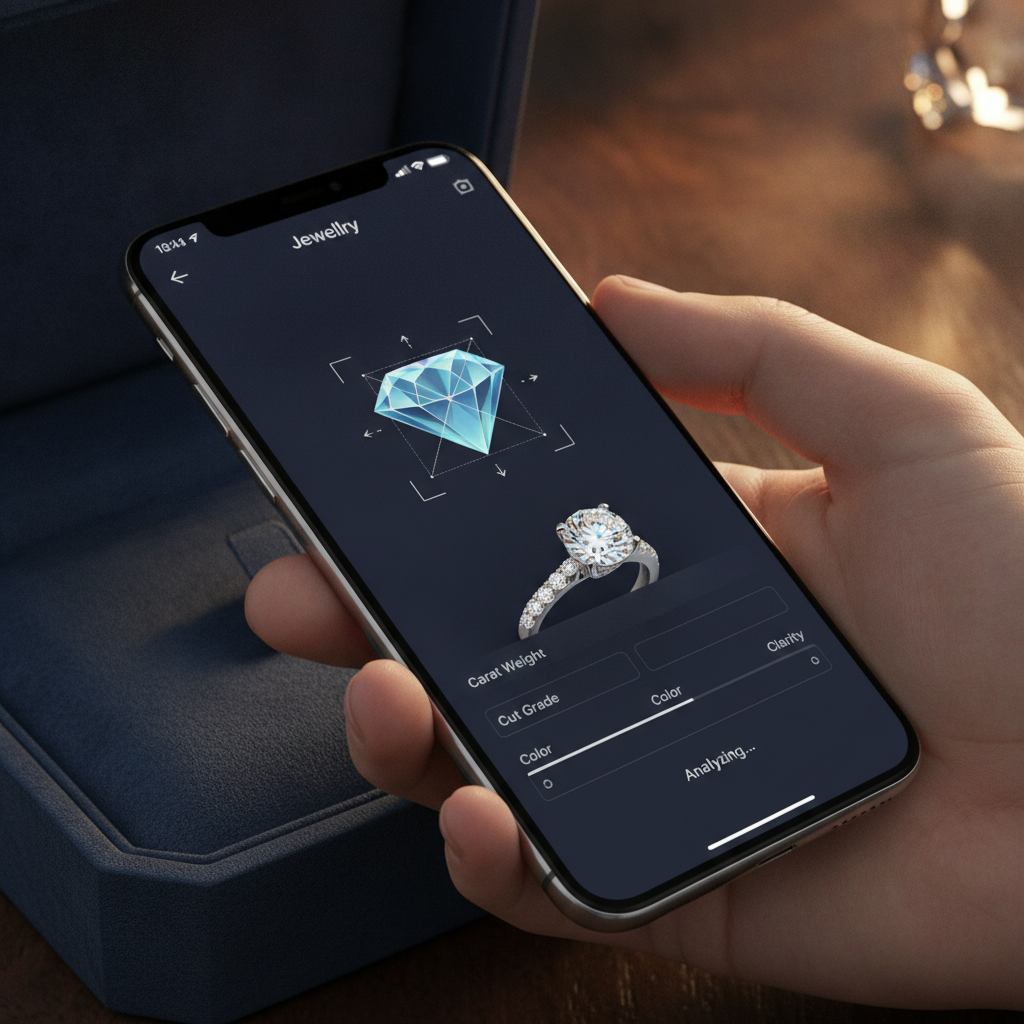
A jewelry identifier app turns your smartphone into a portable gemology assistant. Instead of guessing whether a ring contains genuine sapphire or synthetic spinel, you photograph the piece and receive an AI-powered analysis within seconds. Jewelry Identifier: JewelValue has become one of the most trusted tools in this category, helping collectors, resellers, estate-sale shoppers, and curious owners understand what they actually own.
The technology behind modern jewelry identification combines computer vision, machine learning, and extensive gemological databases. These systems analyze color, transparency, cut style, metal tone, hallmark patterns, setting construction, and surface characteristics visible in a photograph. The best apps compare your image against thousands of verified specimens spanning gemstones, precious metals, costume jewelry, and designer pieces. JewelValue goes further by providing educational context about each identification, including typical value ranges, care instructions, and distinguishing features that separate similar-looking items.
For anyone who has inherited a jewelry box, purchased an unmarked piece at an estate sale, or received a gift without documentation, a jewelry identifier app eliminates the initial guesswork. You no longer need years of gemology training to get a reliable starting point. The app serves as your first expert opinion, which you can then verify through professional appraisal, laboratory testing, or consultation with a certified gemologist when financial stakes justify the expense.
What Is a Jewelry Identifier App?
A jewelry identifier app is a mobile application that uses artificial intelligence and image recognition to analyze photographs of jewelry and suggest what the piece might be. These apps can identify gemstones by visual characteristics, recognize common jewelry styles and settings, detect metal types from color and hallmark clues, and flag pieces that resemble known designer or period styles. They function as digital field guides for anyone who encounters jewelry without provenance.
The core value proposition is speed and accessibility. Traditional jewelry identification requires either sending the piece to a laboratory for spectroscopic analysis or visiting a certified appraiser who examines it under magnification with specialized tools. Both paths are accurate but costly and time-consuming. A jewelry identifier app provides immediate preliminary results that help you decide whether further investigation is worthwhile.
Jewelry Identifier: JewelValue distinguishes itself through breadth of coverage and depth of educational content. The app handles rings, necklaces, bracelets, earrings, brooches, and watches. It works with fine jewelry set with diamonds and colored gemstones, as well as fashion jewelry made from base metals and synthetic stones. This versatility matters because the pieces you encounter in daily life rarely arrive with GIA certificates and detailed receipts.
Modern apps also serve as learning tools. Each identification in JewelValue includes information about the gemstone or metal identified, its typical hardness, common treatments, geographic origins, and market context. Over time, regular use builds your pattern recognition skills, making you a more informed buyer, seller, and collector even when you are not actively using the app.
How Jewelry Identifier: JewelValue Works
Jewelry Identifier: JewelValue uses advanced computer vision models trained on extensive datasets of jewelry photographs. When you capture or upload an image, the app processes it through multiple analysis layers. It examines macroscopic features visible to the camera, including stone color and transparency, facet patterns, metal color and finish, prong or bezel construction, and any visible hallmarks or maker's marks.
The identification process typically completes within seconds. Results include the most likely gemstone, metal, or jewelry type, a confidence indicator, and a detailed profile covering physical and market properties. You will see information about typical treatments for that stone type, common simulants and synthetics to watch for, and care recommendations that help preserve the piece.
One of the app's greatest strengths is handling the ambiguity inherent in jewelry identification from photographs alone. Many gemstones share visual similarities. A blue stone could be sapphire, tanzanite, topaz, or glass. Yellow stones might be citrine, yellow sapphire, or treated quartz. JewelValue often provides multiple possible matches ranked by likelihood, along with practical tips for distinguishing between them using simple tests or professional verification.
The app also learns from context you provide. Selecting the jewelry category (ring, necklace, etc.) and noting any visible markings improves accuracy. For inherited pieces, photographing the piece under natural daylight against a neutral background produces the clearest results. These small workflow choices significantly improve the quality of your identification experience.
Key Features That Set JewelValue Apart
Jewelry Identifier: JewelValue offers a comprehensive suite of features designed for both casual users and serious collectors. The core photo identification engine supports jewelry in various conditions, from pristine showroom pieces to worn vintage items with patina and minor damage. This real-world flexibility matters because estate finds and inherited collections rarely look like catalog photographs.
The personal collection feature lets you save every identification along with the original photo, date, and optional notes about provenance or purchase price. Over time, this builds into a valuable digital catalog of your jewelry. For resellers and estate liquidators, this collection tracker becomes an indispensable inventory system that would otherwise require spreadsheets and separate photo albums.
Educational content accompanies every identification. Rather than simply naming a stone, JewelValue explains why your piece matches that classification. You learn about the gem's formation, typical inclusions, common enhancement treatments, and how market value varies with quality factors like color saturation, clarity, and cut precision. This transforms each identification into a practical lesson in gemology.
The interface is designed for everyday use with intuitive navigation, clear typography, and a workflow that gets you from photo to result in minimal steps. Whether you are at an estate sale deciding whether to bid on a lot, at home cataloging inherited pieces, or in a jewelry store verifying a salesperson's claims, the streamlined experience makes a genuine difference.
Additional features include value estimation ranges based on current market data, identification history for tracking your learning journey, and regular database updates that expand coverage as new jewelry styles and gemstone treatments enter the market. These ongoing improvements demonstrate the developer's commitment to maintaining a tool that grows more useful with every update.
Who Benefits from Using a Jewelry Identifier App?
Jewelry identifier apps serve a remarkably diverse audience. Estate sale shoppers and flea market vendors use JewelValue to quickly assess whether unmarked pieces warrant closer inspection or professional appraisal. A preliminary identification that suggests genuine alexandrite or Art Deco platinum construction changes how you evaluate an asking price.
Collectors building reference sets use the app to catalog inherited jewelry where provenance is unknown. Grandmother's jewelry box often contains a mix of fine pieces, sentimental costume jewelry, and mysteries that have puzzled the family for decades. JewelValue helps sort the collection systematically, identifying which pieces deserve insurance riders and which are beloved but modest in material value.
Jewelry resellers on platforms like eBay, Poshmark, and Etsy rely on accurate identification for honest listings. Misidentifying a garnet as ruby or gold-plated brass as solid gold creates legal liability and damages seller reputation. A jewelry identifier app provides a verification step before you write a listing description, reducing costly errors.
Buyers negotiating at jewelry stores use the app as an independent second opinion. When a salesperson describes a stone as "blue sapphire" but JewelValue suggests iolite or synthetic spinel based on visual characteristics, you know to request a gemological report before committing to a significant purchase.
Insurance professionals and estate attorneys increasingly recommend jewelry identifier apps as a first step in documenting assets. While formal appraisals remain necessary for policy underwriting above certain thresholds, preliminary identification helps clients understand what they own before scheduling expensive professional evaluations.
Even certified gemologists appreciate having a quick reference in their pocket. While no app replaces refractometer readings, spectroscopy, or microscopic examination, it provides a fast preliminary identification that guides which confirmatory tests are worth performing in a laboratory setting.
Tips for Getting the Best Identification Results
Photography technique dramatically affects jewelry identification accuracy. Use natural daylight whenever possible, as artificial lighting introduces color casts that confuse both human eyes and AI algorithms. Position the piece near a window on an overcast day for the most neutral illumination. Avoid direct sunlight, which creates harsh shadows and blown-out highlights that obscure facet patterns and color depth.
Clean the jewelry gently before photographing. Fingerprints, dust, and lotion residue on stones and metal surfaces reduce clarity in your image. A soft microfiber cloth and mild soap solution for durable pieces improve results significantly. For delicate antique jewelry, dry brushing with a soft brush is safer than submersion.
Capture multiple angles. A single top-down photo of a ring rarely reveals enough information for confident identification. Photograph the face, profile, underside (where hallmarks often appear), and any distinguishing details like engravings or maker's marks. JewelValue processes each image and synthesizes information across your photo set for more reliable results.
Include a size reference when possible. Placing the piece next to a standard coin or ruler helps the app calibrate scale, which aids in distinguishing between similar stones that differ in typical carat weight for a given setting style. This is especially helpful for earrings and small accent stones.
Photograph hallmarks and stamps at high magnification. Use your phone's macro mode or an inexpensive clip-on macro lens to capture crisp images of tiny markings. "14K," "585," "PLAT," designer signatures, and country-of-origin stamps provide crucial metal identification clues that visual stone analysis alone cannot determine.
Avoid heavily filtered or edited photos. Beauty filters, saturation boosts, and artificial backgrounds interfere with color analysis. Present the jewelry as accurately as possible. The goal is identification, not Instagram aesthetics.
When results seem uncertain, use JewelValue's ranked possibilities as a guide for targeted follow-up. If the app lists three possible blue gemstones, research the distinguishing tests for each and consider whether professional verification is justified given the piece's apparent value.
Jewelry Identification vs. Professional Appraisal
Understanding the difference between app-based identification and professional appraisal protects you from costly assumptions. A jewelry identifier app like JewelValue provides preliminary identification based on visual analysis. It tells you what your piece most likely is, supported by gemological knowledge and market context. This is invaluable for education, initial sorting, and deciding whether to invest in further verification.
A professional jewelry appraisal is a formal document prepared by a certified appraiser who physically examines the piece using gemological instruments. Appraisers measure precise carat weight, test metal purity with acid or X-ray fluorescence, evaluate clarity and color against standardized grading scales, and assess craftsmanship and condition. The resulting report carries legal and insurance weight that app identification cannot provide.
The two approaches complement each other rather than competing. Use JewelValue for everyday identification, learning, and preliminary valuation when browsing estate sales or organizing inherited collections. Reserve professional appraisal for pieces where financial, insurance, or legal stakes justify the expense, typically items valued above $1,000 or any piece requiring documentation for an insurance rider, estate settlement, or divorce proceeding.
Laboratory gemological reports from organizations like GIA, AGS, or IGI provide yet another tier of verification for individual gemstones. These reports use spectroscopy, microscopy, and other instruments to definitively identify species, detect treatments, and grade quality. For diamond purchases above several thousand dollars, a lab report is standard practice. JewelValue can flag when a lab report is recommended based on the stone type and apparent quality.
The smart workflow tiers your approach: photograph with JewelValue for immediate answers, request lab reports for significant unset or loose gemstones, and schedule full appraisals for complete jewelry pieces requiring insurance documentation. This tiered strategy saves money while ensuring high-value items receive appropriate professional attention.
Common Jewelry Types and What to Look For
Rings represent the most commonly identified jewelry category. Engagement rings, cocktail rings, signet rings, and stackable bands each follow distinct construction patterns. When identifying rings, examine the center stone's cut style (round brilliant, cushion, emerald, oval), setting type (prong, bezel, halo, tension), and band metal characteristics. Solitaire diamond rings dominate the market, but colored gemstone center stones require careful species identification because simulants are common in fashion jewelry.
Necklaces and pendants introduce chain construction and clasp types as additional identification clues. Fine chains in gold and platinum display specific link patterns (cable, rope, box, snake) that indicate manufacturing method and quality level. Pendant stones are often larger than ring accent stones, making color and inclusion patterns easier to photograph and analyze with JewelValue.
Bracelets range from delicate tennis bracelets with continuous diamond lines to chunky charm bracelets and rigid bangles. Tennis bracelets require evaluating dozens of small stones for consistency in color and clarity. Charm bracelets carry individual charms that may be made from different metals and eras, requiring piece-by-piece identification.
Earrings present unique challenges because pairs should match. Stud earrings with post backs differ from hook dangles and hinged hoops. Identifying earring gemstones benefits from photographing both earrings together to confirm they are a matched pair with consistent stone characteristics.
Brooches and pins, popular in vintage and antique jewelry, often feature intricate metalwork and multiple stone types in a single piece. Art Deco brooches might combine diamonds, onyx, and coral in geometric designs. Victorian brooches frequently use seed pearls, garnets, and turquoise in floral motifs. JewelValue recognizes many period styles, helping date and identify these complex pieces.
Watches with jewelry elements (diamond bezels, gemstone dials) combine horological and gemological identification challenges. Metal case markings, movement signatures, and stone settings each provide separate clues that contribute to overall piece identification and valuation.
Frequently Asked Questions
How accurate is the Jewelry Identifier app?
Jewelry Identifier: JewelValue achieves strong accuracy on common gemstones, popular jewelry styles, and standard precious metal presentations. Accuracy depends on photo quality, lighting conditions, and the complexity of the piece. For straightforward items like solitaire diamond rings, gold chains, and common colored gemstones in standard settings, the app provides reliable preliminary identifications. Complex pieces with multiple stone types, heavy wear, or unusual treatments may produce broader possibility ranges. The app is designed as an educational and preliminary identification tool, not a replacement for laboratory gemological testing or certified appraisal.
Can the app identify gold and silver jewelry?
Yes. JewelValue analyzes metal color, luster, and any visible hallmarks to suggest whether a piece is likely solid gold, gold-filled, gold-plated, sterling silver, platinum, or base metal. Visible stamps like "14K," "18K," "925," "STER," and "PLAT" significantly improve metal identification accuracy. For pieces without visible markings, the app evaluates surface color and wear patterns. However, definitive metal purity testing requires physical assays that cannot be performed through photography alone. Use app results as a strong indicator and confirm with professional testing before making financial decisions based on metal content.
Does JewelValue work with vintage and antique jewelry?
Absolutely. Vintage and antique jewelry is a core use case for JewelValue. The app recognizes period-typical stone types, setting styles, and metalwork patterns associated with Victorian, Edwardian, Art Nouveau, Art Deco, and Retro eras. Many inherited pieces lack documentation, and JewelValue helps owners understand what they have before deciding whether to seek professional appraisal. Keep in mind that antique pieces may have been repaired, resized, or modified over decades, which can complicate identification. Photograph all hallmarks, maker's marks, and construction details for the best results.
Is my jewelry photo data kept private?
Jewelry Identifier: JewelValue processes your photographs to generate identifications. Review the app's privacy policy for current data handling practices. For valuable or sentimental pieces, many users feel comfortable photographing jewelry for identification since the images are used solely for analysis rather than being published or shared. If privacy is a primary concern, focus on photographing individual components rather than entire collections in a single image, and review app permissions to understand what data is stored locally versus transmitted for processing.
How does JewelValue compare to visiting a jeweler?
JewelValue provides immediate, free or low-cost preliminary identification available anytime you have your phone. Visiting a jeweler offers physical examination with gemological tools, verbal expertise, and sometimes complimentary evaluations for potential sales or repairs. Jewelers may have conflicts of interest when assessing pieces they might purchase. JewelValue provides an independent first opinion without sales pressure. The ideal approach combines both: use the app for quick identification and education, then visit an independent certified appraiser or gemologist for high-value pieces requiring formal documentation.
Download Jewelry Identifier: JewelValue Today
Whether you are cataloging an inherited collection, shopping estate sales, or simply curious about a piece you wear every day, Jewelry Identifier: JewelValue puts expert-level jewelry identification in your pocket. Simply snap a photo of any ring, necklace, bracelet, earring, or brooch and receive detailed results within seconds.
The app covers thousands of gemstones, metals, and jewelry styles with information on identification characteristics, typical value ranges, care instructions, and market context. Save your identifications to build a personal jewelry catalog and learn something new with every piece you photograph.
Download Jewelry Identifier: JewelValue on the App Store and start identifying your jewelry today.