Moissanite has become one of the most important gemstones to identify accurately in modern jewelry. As a popular diamond alternative in engagement rings and fine jewelry, moissanite's visual similarity to diamond creates both opportunity and confusion. Buyers seeking affordable brilliance want genuine moissanite. Diamond purchasers want assurance they are not paying diamond prices for moissanite. Estate sale hunters need to know what they have found. This guide covers moissanite's properties, identification methods, and how Jewelry Identifier: JewelValue helps distinguish moissanite from diamond and other lookalike stones.
Natural moissanite was first discovered in 1893 by Henri Moissan in meteorite fragments from Arizona's Canyon Diablo. These natural crystals were tiny and rare, making them irrelevant to the jewelry trade for a century. Everything changed in the 1990s when Charles & Colvard developed commercial processes for creating gem-quality synthetic moissanite crystals. Today, moissanite is manufactured by several companies worldwide and has established itself as a legitimate gemstone category with its own grading standards, market pricing, and devoted following.
The identification challenge stems from moissanite's remarkable optical properties. With a refractive index of 2.65-2.69 (higher than diamond's 2.42), moissanite displays intense brilliance and even more fire (light dispersion) than diamond. To the untrained eye, a well-cut moissanite can appear identical to diamond. Standard thermal conductivity diamond testers register moissanite as diamond, creating a well-known trap for buyers and sellers who rely on inexpensive testing pens alone. Accurate moissanite identification requires multiple testing approaches or AI visual analysis through tools like JewelValue.
What Is Moissanite?
Moissanite is silicon carbide (SiC), a compound of silicon and carbon crystallized in the hexagonal crystal system. It should not be confused with other diamond simulants: cubic zirconia is zirconium dioxide (ZrO₂), white sapphire is corundum (Al₂O₃), and diamond is pure carbon (C). Each material has distinct physical and optical properties that identification methods exploit.
Gem-quality moissanite used in jewelry is exclusively laboratory-created. No commercial jewelry contains natural moissanite because natural crystals are microscopic. The manufacturing process grows silicon carbide crystals under controlled conditions, then cuts and polishes them into faceted gemstones. Major producers include Charles & Colvard (USA), Cree/Wolfspeed, and various Asian manufacturers supplying the global market.
Moissanite ranks 9.25 on the Mohs hardness scale, making it the second-hardest material used in jewelry after diamond (10). This exceptional hardness means moissanite maintains crisp facet edges through years of daily wear, unlike cubic zirconia (hardness 8-8.5) which gradually rounds and dulls. Moissanite's durability makes it genuinely suitable for engagement rings and everyday jewelry, not merely a temporary diamond substitute.
Standard moissanite is near-colorless, equivalent to G-I on the diamond color scale. Premium "forever brilliant" and similar branded grades push toward D-F colorless territory. Colored moissanite in yellow, green, blue, and other hues is available but less common. Moissanite's clarity is typically very high because the controlled growth environment minimizes inclusions. Most jewelry-grade moissanite appears eye-clean, similar to VVS-VS clarity diamonds.
Optical Properties That Distinguish Moissanite
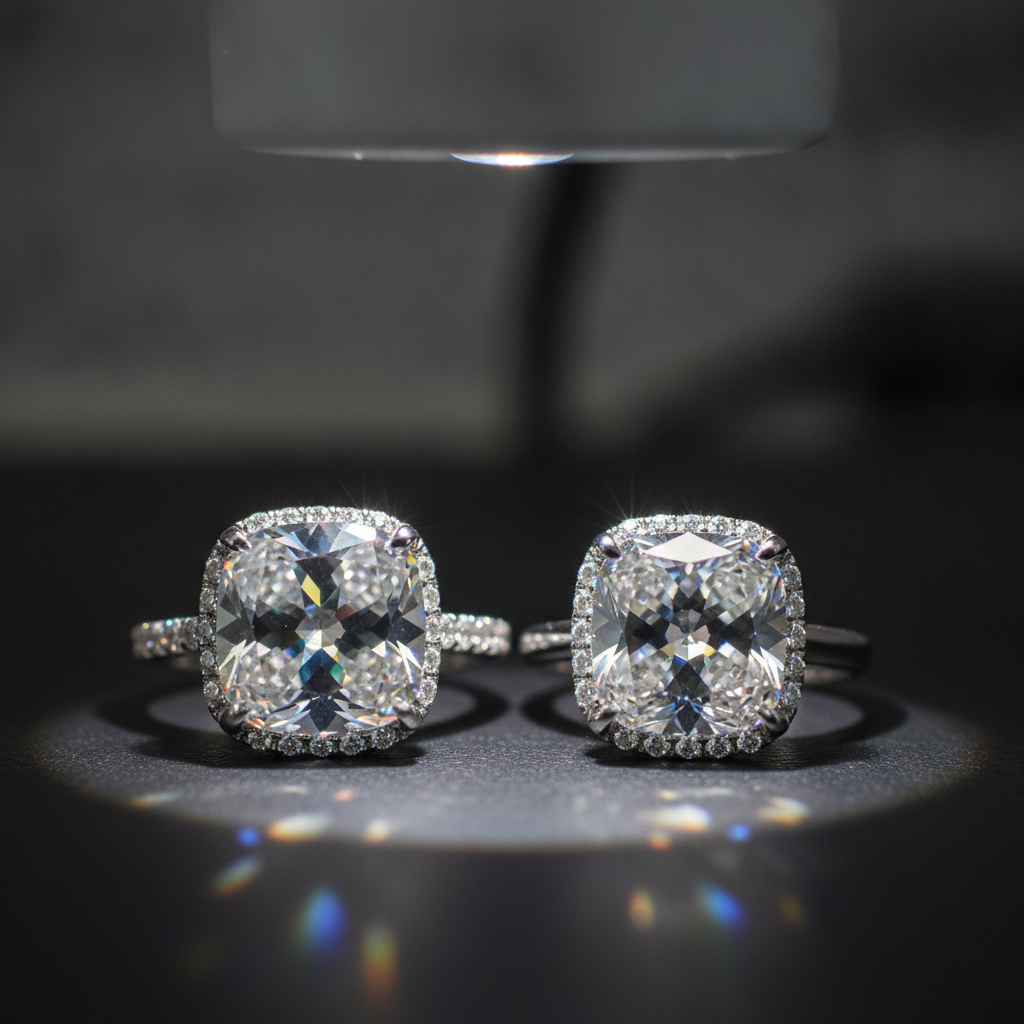
Brilliance and fire are the primary visual characteristics that separate moissanite from diamond and other simulants. Brilliance refers to white light reflected from a gemstone's interior and surface. Fire refers to colored light dispersion, the rainbow flashes that occur when white light separates into spectral colors within the stone. Moissanite's higher refractive index produces more fire than diamond, a characteristic that experienced observers describe as "disco ball" or "rainbow" effect, especially under point light sources.
In direct sunlight or under spot lighting, moissanite's excess fire becomes most apparent. Diamonds display balanced brilliance and fire, with white flash predominating. Moissanite shows pronounced colored flashes that can appear almost artificial in comparison. However, this distinction requires experience and good lighting conditions. Under diffuse lighting or in mounted settings with smaller stones, the fire difference becomes subtler, which is why photographic AI analysis through JewelValue adds value to visual assessment.
Double refraction is a definitive optical property of moissanite that diamond lacks. Moissanite is doubly refractive (birefringent), meaning light entering the crystal splits into two rays traveling at different speeds. This produces a doubling effect on facet edges and internal features when viewed through a loupe. Diamond is singly refractive, showing no doubling. Observing facet doubling through 10x magnification is a reliable field test for moissanite identification, though it requires practice to recognize.
Luster differs subtly between moissanite and diamond. Moissanite exhibits adamantine to metallic luster, while diamond shows adamantine luster exclusively. In practice, moissanite can appear slightly more "glassy" or "metallic" than diamond under certain lighting, but this difference is subtle enough that most casual observers miss it without side-by-side comparison.
Specific gravity provides another distinguishing data point. Moissanite's specific gravity is approximately 3.22, while diamond is 3.52. This difference is measurable with hydrostatic weighing equipment in a gemological laboratory but is not practical for field identification. JewelValue infers likely identity from optical characteristics visible in photographs rather than measuring physical constants.
Testing Methods for Moissanite Identification
Thermal conductivity testing is the most common field test for diamond identification. Diamond conducts heat exceptionally well; most simulants do not. However, moissanite's thermal conductivity is close enough to diamond's that standard diamond testers register moissanite as diamond. This is the single most important testing pitfall in gemstone identification. A positive diamond tester result does not confirm diamond; it confirms either diamond or moissanite.
Electrical conductivity testing distinguishes moissanite from diamond. Moissanite conducts electricity; diamond does not. Combination testers that measure both thermal and electrical conductivity reliably separate the two stones. These dual testers cost $200-400 and are standard equipment in pawn shops and jewelry stores that regularly evaluate unmarked stones. If you frequently buy or sell jewelry, investing in a combination tester is worthwhile.
The loupe test for double refraction requires only a 10x jeweler's loupe. Examine facet junctions and internal features through the crown (top) of the stone. In moissanite, facet edges appear doubled or ghosted. In diamond, edges appear single and crisp. This test works best on loose stones larger than 3mm; in small mounted stones, the doubling effect is harder to observe. Practice on known specimens builds the visual skill needed for reliable assessment.
UV fluorescence provides a supplementary clue. Many diamonds fluoresce blue under long-wave ultraviolet light; moissanite typically does not fluoresce or shows weak fluorescence. This test is suggestive rather than definitive because some diamonds also lack fluorescence, and fluorescence intensity varies widely among diamonds.
Professional gemological laboratories use spectroscopy for definitive identification. Raman spectroscopy, infrared spectroscopy, and X-ray diffraction each identify moissanite's silicon carbide crystal structure unambiguously. GIA, IGI, and other major labs include moissanite identification in their standard testing protocols. For high-value transactions, laboratory reports provide the certainty that field tests and visual analysis cannot.
JewelValue offers a non-destructive, accessible first step in moissanite identification. The app analyzes fire patterns, brilliance characteristics, and visual properties visible in photographs to suggest whether a stone is likely moissanite, diamond, or another simulant. This preliminary identification guides which physical tests or laboratory verification are appropriate for the situation.
Moissanite vs. Diamond: A Side-by-Side Comparison
Understanding the practical differences between moissanite and diamond helps buyers make informed choices and helps owners identify what they have. Price is the most obvious distinction. A one-carat near-colorless moissanite costs $300-600 retail, while an equivalent-quality one-carat natural diamond costs $4,000-8,000 or more. Lab-grown diamonds have narrowed this gap somewhat but moissanite remains significantly less expensive at every size.
Ethical and environmental considerations drive some buyers toward moissanite. All moissanite is laboratory-created, eliminating mining concerns entirely. Natural diamond mining has well-documented environmental and social impacts, though the Kimberley Process and responsible sourcing initiatives address conflict diamond concerns. Lab-grown diamonds offer a similar ethical profile to moissanite. JewelValue identifies the gemstone species but does not determine origin; buyers with ethical sourcing priorities should verify origin claims independently.
Resale value differs dramatically. Diamonds, particularly natural diamonds with laboratory reports, retain partial value on the secondary market. Moissanite has minimal resale value because new stones are inexpensive and readily available. If future resale matters to your purchase decision, diamond holds value better despite higher initial cost. If you are purchasing a stone to wear and enjoy without resale intent, moissanite delivers exceptional beauty per dollar.
Durability is comparable for daily wear purposes. Diamond's Mohs 10 hardness exceeds moissanite's 9.25, but both are hard enough that normal activities will not scratch either stone. The practical durability difference is negligible for jewelry purposes. Both require similar care: regular cleaning, prong inspection, and removal during heavy-impact activities.
Visual preference is ultimately personal. Some buyers prefer diamond's balanced fire and prestige. Others prefer moissanite's intense brilliance and value proposition. Neither choice is objectively wrong. JewelValue helps ensure you know which stone you are actually purchasing or owning, so your preference aligns with reality rather than assumption.
Moissanite in the Jewelry Market
Moissanite appears most frequently in engagement rings, where its diamond-like appearance at fraction-of-the-cost pricing attracts budget-conscious couples and ethically minded buyers. Solitaire moissanite rings in sterling silver or gold settings range from $200-2,000 depending on stone size and metal quality. These rings are honestly marketed as moissanite by reputable sellers.
The problem arises with dishonest or uninformed sellers who misrepresent moissanite as diamond. Online marketplaces, estate sales, and informal transactions occasionally feature moissanite pieces described as diamond. Without identification tools, buyers overpay dramatically. JewelValue provides a quick verification step before committing to purchases, potentially saving thousands of dollars.
Moissanite is also set as accent stones in fashion jewelry and occasionally mixed with genuine diamonds in multi-stone pieces. Identifying each stone in a complex setting requires examining individual stones, which JewelValue supports through close-up photography of each component.
Charles & Colvard remains the most recognized moissanite brand, with patented cuts and quality grades. Other manufacturers produce comparable material often sold under retailer house brands. Brand identification affects value modestly in moissanite because the material itself is standardized. Cut quality and size are the primary value drivers.
The moissanite market continues evolving with improved color grades, larger available sizes, and fancy shapes matching diamond cutting trends. Oval, cushion, and pear moissanite shapes have gained popularity alongside their diamond counterparts. As the market matures, moissanite identification skills become increasingly relevant for jewelry professionals and consumers alike.
Using JewelValue to Identify Moissanite
Photograph the stone under natural daylight with your phone camera. Position the stone to capture both brilliance and fire patterns. Include the setting and any hallmarks in additional photographs. Open Jewelry Identifier: JewelValue and submit your images for analysis.
The app evaluates optical characteristics including fire intensity, brilliance pattern, facet geometry, and color presentation. When moissanite is the most likely identification, JewelValue explains the visual markers that support this conclusion, such as pronounced fire relative to brilliance and characteristic optical behavior.
For mounted stones, photograph from multiple angles to give the AI maximum visual data. Include macro shots of facet patterns if your camera supports close focus. The app's confidence increases with photograph quality and quantity.
Compare JewelValue results with physical testing when possible. If the app suggests moissanite and you have access to a combination thermal/electrical conductivity tester, verify the result. If the app suggests diamond but you suspect moissanite based on purchase price or provenance, the electrical conductivity test resolves the ambiguity.
Save identifications to your JewelValue collection for future reference. If you later sell the piece, documented identification supports honest listing descriptions and buyer confidence.
Frequently Asked Questions
Can a jeweler tell moissanite from diamond?
Experienced jewelers with proper equipment can reliably distinguish moissanite from diamond. They use combination thermal/electrical conductivity testers, loupe examination for double refraction, and spectroscopic instruments in well-equipped shops. However, not all jewelers have dual testers, and some rely on standard diamond testers that cannot separate the two stones. JewelValue provides an independent preliminary identification you can compare against a jeweler's assessment.
Does moissanite pass a diamond tester?
Yes. Standard thermal conductivity diamond testers register moissanite as diamond because moissanite conducts heat similarly to diamond. This is the most common identification trap in the jewelry trade. Only combination testers that also measure electrical conductivity reliably distinguish moissanite (conductive) from diamond (non-conductive). Never rely on a single thermal diamond tester alone to confirm diamond identity.
Is moissanite worth anything?
Moissanite has modest resale value compared to its retail price. A moissanite engagement ring purchased for $1,500 might resell for $200-400. The stone's beauty and durability are its value propositions, not investment potential. For insurance purposes, moissanite is valued at replacement cost, which remains low relative to diamond. JewelValue provides current market value ranges for moissanite jewelry based on stone size and setting quality.
How does moissanite compare to cubic zirconia?
Moissanite is superior to cubic zirconia in every meaningful quality metric. Moissanite is harder (9.25 vs 8-8.5), maintaining crisp facets through years of wear while CZ gradually dulls and scratches. Moissanite's optical properties more closely approximate diamond, with stronger brilliance and more convincing appearance. CZ costs less ($20-50 per carat versus $300-600 for moissanite) but looks correspondingly less diamond-like. JewelValue reliably distinguishes both from diamond and from each other based on optical characteristics.
Should I choose moissanite or diamond for an engagement ring?
This is a personal decision based on budget, values, and preferences. Moissanite offers exceptional beauty at 10-15% of diamond cost with ethical laboratory creation. Diamond offers prestige, tradition, and better resale value. Both are durable enough for daily wear. Use JewelValue to verify you receive the stone you choose, regardless of which option you select. Some couples choose moissanite for the engagement ring and natural diamond accents, blending value and tradition.
Download Jewelry Identifier: JewelValue Today
Moissanite identification requires more than a simple diamond tester. Jewelry Identifier: JewelValue analyzes optical properties from your photographs to distinguish moissanite from diamond, cubic zirconia, and other simulants with detailed explanations you can trust.
Download Jewelry Identifier: JewelValue on the App Store and identify moissanite with confidence today.