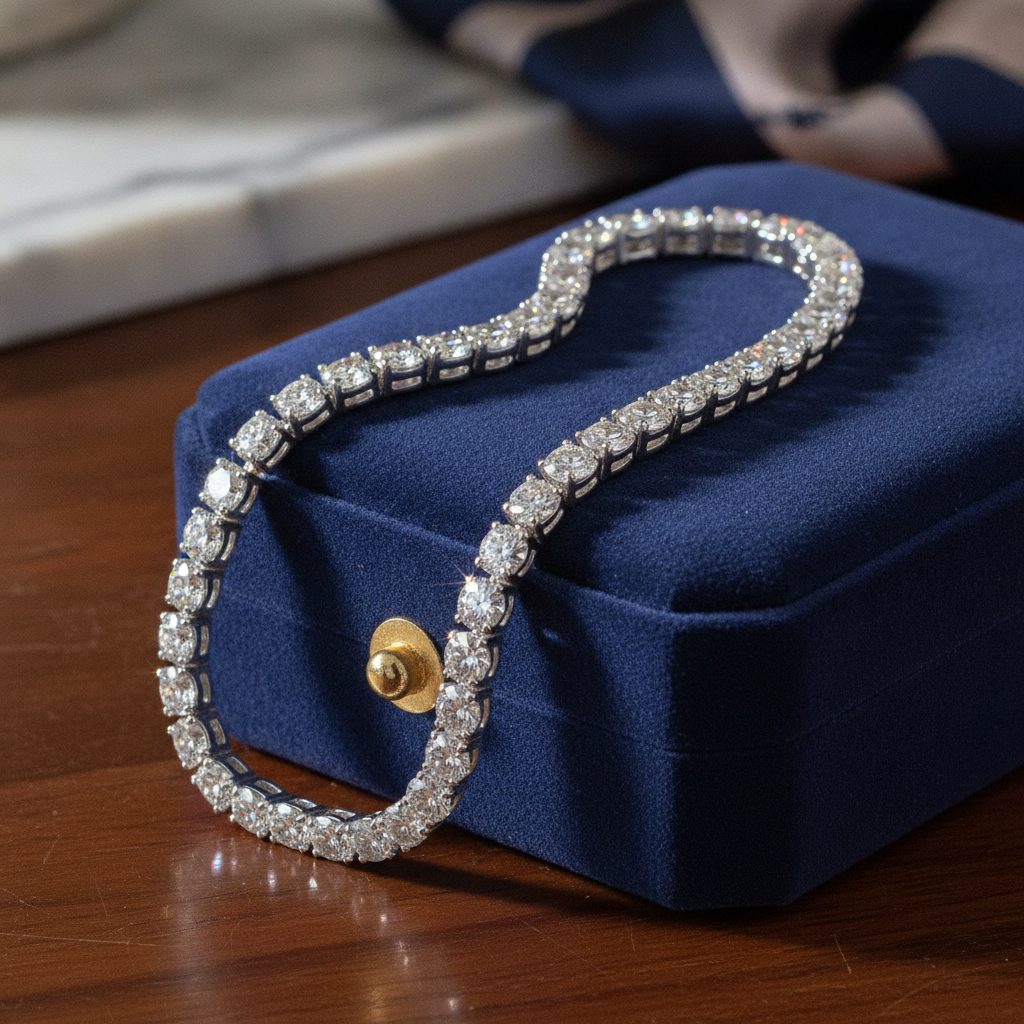
The tennis bracelet is one of the most recognizable and enduring designs in fine jewelry. A flexible line of individually set diamonds circling the wrist, the tennis bracelet balances elegance with everyday wearability. Whether you own one, are shopping for one, or found an unmarked bracelet at an estate sale, understanding how to identify and evaluate tennis bracelets protects your investment. This guide covers the design's history, construction quality factors, diamond evaluation, and how Jewelry Identifier: JewelValue helps assess tennis bracelets from photographs.
The name "tennis bracelet" originated from a 1987 incident during the US Open when professional tennis player Chris Evert stopped a match to search for her diamond line bracelet that had broken and fallen on the court. The event generated enormous media attention, and jewelers nationwide reported surging demand for what had previously been called an "in-line diamond bracelet" or "diamond line bracelet." The catchy name stuck, and the tennis bracelet became a jewelry staple purchased for anniversaries, birthdays, graduations, and self-gifts.
Tennis bracelets range from accessible fashion jewelry with small cubic zirconia stones in silver settings to extraordinary pieces featuring dozens of matched diamonds totaling several carats in platinum mountings worth tens of thousands of dollars. This range makes identification skills valuable. An inherited tennis bracelet without documentation could be worth $200 or $20,000 depending on whether the stones are genuine diamonds and the metal is platinum or plated brass. JewelValue provides the preliminary answers that guide your next steps.
The History and Evolution of Tennis Bracelets
Diamond line bracelets existed long before Chris Evert's famous match. Art Deco jewelers of the 1920s and 1930s created flexible diamond bracelets featuring geometric patterns of round and baguette diamonds set in platinum. These vintage pieces often surpass modern tennis bracelets in craftsmanship, with hand-set stones and intricate link construction. Identifying vintage versus modern tennis bracelets involves examining setting style, metalwork, clasp design, and diamond cut types.
The modern tennis bracelet standardized around a single row of uniformly sized round brilliant diamonds set in four-prong baskets linked together with flexible joints. This design maximizes total carat weight visible on the wrist while maintaining comfort and flexibility. Variations include two-row designs, alternating stone sizes, and mixed diamond shapes, but the single-row round brilliant remains the classic.
Tennis bracelets experienced a resurgence in the 2000s and 2010s as diamond prices became more accessible and lab-grown diamonds entered the market. Today, tennis bracelets are available at virtually every price point, from fashion jewelry retailers to high jewelry houses. The democratization of the design makes accurate identification more important than ever, as visually similar bracelets can differ in value by two orders of magnitude.
Tennis Bracelet Construction and Settings
A quality tennis bracelet's foundation is its link mechanism. Each diamond sits in an individual setting (typically four-prong basket) connected to the next by a flexible link that allows the bracelet to drape naturally around the wrist. Links should move smoothly without catching, and the overall bracelet should feel fluid rather than stiff. Cheap tennis bracelets use rigid connections that are uncomfortable and prone to breaking.
Prong settings are standard for tennis bracelets, holding each diamond with four thin metal prongs that minimize metal visibility while securing the stone. Six-prong settings appear on larger stones for added security. Bezel settings surround each diamond with a metal rim, offering maximum stone protection for active wearers at the cost of slightly reduced light entry. Channel-set tennis bracelets hold diamonds in a groove between two metal walls, creating a sleek continuous surface.
Metal choice affects both durability and value. Platinum tennis bracelets represent the premium tier: dense, durable, naturally white, and hypoallergenic. 14-karat and 18-karat white gold are popular alternatives at lower cost. Yellow gold tennis bracelets offer warm classic appeal. Sterling silver tennis bracelets with cubic zirconia occupy the fashion jewelry tier. The metal type is often stamped on the clasp: look for "PT950," "14K," "18K," "925," or similar marks.
Clasp quality is critical for tennis bracelets because the entire piece depends on a single closure point. Fine tennis bracelets feature box clasps with figure-eight safety latches, fold-over clasps with double safety mechanisms, or lobster clasps on lighter designs. The clasp should feel substantial and click securely. A flimsy clasp on an otherwise fine bracelet is a red flag suggesting possible counterfeit or poor repair.
Total carat weight for tennis bracelets typically ranges from 2 to 10 carats, distributed across 20 to 50 or more individual stones. Average stone size correlates with total carat count: a 3-carat total bracelet with 30 stones averages 0.10 carats (approximately 3mm) per stone. Larger total carat weights with fewer stones mean larger individual diamonds and exponentially higher prices.
Evaluating Diamonds in a Tennis Bracelet
Diamond quality in tennis bracelets is evaluated differently than solitaire rings because individual stone grades matter less than overall visual consistency. When thirty diamonds are viewed together on a wrist, uniformity of appearance outweighs the grade of any single stone. Jewelers select diamonds that match in color and clarity when assembling tennis bracelets, creating a cohesive line without individual stones standing out as warmer, cloudier, or duller than their neighbors.
Color matching is paramount. Most tennis bracelets use diamonds in the G-J color range, appearing white when set in white metal and viewed as a group. A single noticeably yellow stone in the line disrupts the entire bracelet's appearance and indicates poor quality control or later replacement with an unmatched stone. Photograph the bracelet in natural daylight and examine color consistency across all stones. JewelValue analyzes color uniformity from photographs and flags potential inconsistencies.
Clarity requirements are more relaxed than for solitaire stones because individual diamonds in tennis bracelets are small enough that SI1-SI2 inclusions are typically invisible to the naked eye. Many fine tennis bracelets use SI clarity diamonds that appear clean when worn. I1 clarity and below may show visible inclusions that affect the bracelet's overall sparkle. Examine the bracelet under bright light, rotating it to catch reflections from each stone.
Cut quality in tennis bracelet diamonds is often Good to Very Good rather than Excellent, because the small stone sizes (typically 2-4mm diameter) show less cut variation in wear than larger stones. However, poorly cut stones in a tennis bracelet create noticeable dull spots in the line. Each stone should contribute equal brilliance to the overall effect.
Certification for tennis bracelets varies. Some fine bracelets include a total carat weight and average color/clarity grade on a retail certificate. Individual GIA reports for each small stone are impractical and rare. For high-value tennis bracelets, a GIA report on the center or largest stone plus documented total carat weight from the selling jeweler is standard. Estate and pre-owned bracelets rarely include documentation, making JewelValue identification particularly valuable.
Identifying Genuine vs. Fashion Tennis Bracelets
The most important identification question for an unmarked tennis bracelet is whether the stones are genuine diamonds or simulants (cubic zirconia, moissanite, white sapphire). Visual inspection provides initial clues. Genuine diamonds show balanced brilliance and fire with crisp facet patterns. Cubic zirconia appears overly brilliant with a glassy quality and may show wear on facet edges. Moissanite displays excessive rainbow fire under point lighting.
Metal analysis supports stone identification. Genuine diamond tennis bracelets are set in gold or platinum, with hallmarks on the clasp. A "CZ" or "925" stamp confirms cubic zirconia in sterling silver. Absence of hallmarks does not prove simulant, as some fine pieces lack stamps, but the combination of unmarked metal and suspiciously perfect large stones at low acquisition cost suggests fashion jewelry.
Weight provides a useful indicator. A genuine 3-carat diamond tennis bracelet in 14-karat gold weighs noticeably more than a CZ equivalent due to diamond's higher density (3.52) versus CZ (5.5-5.9, actually heavier) and gold's substantial mass. However, the comparison is most useful when you have a known reference piece.
Professional testing with a diamond tester (thermal conductivity) provides quick field identification for individual stones. Test multiple stones along the bracelet, as some dishonest pieces mix genuine diamonds in the center with simulants toward the clasp where inspection is less thorough. Moissanite requires electrical conductivity testing in addition to thermal testing.
JewelValue analyzes tennis bracelet photographs to suggest whether stones are likely diamond, moissanite, cubic zirconia, or other materials based on optical characteristics. The app also evaluates metal type from clasp photographs and provides estimated value ranges based on identified materials and apparent quality.
Tennis Bracelet Sizing and Fit
Proper fit is essential for tennis bracelet comfort and security. Measure wrist circumference with a flexible tape measure, then add 0.5 to 1 inch for comfortable fit. Standard sizes are 6.5 inches (small), 7 inches (medium, most common), 7.5 inches (large), and 8 inches (extra large). A properly fitted tennis bracelet allows one finger to slip between the bracelet and wrist.
Too-tight bracelets stress clasp mechanisms and link joints, increasing breakage risk. Too-loose bracelets catch on clothing and slide around the wrist uncomfortably. Most tennis bracelets can be sized by removing or adding links at a jeweler, though this affects total carat weight slightly when links containing diamonds are removed.
When purchasing pre-owned or estate tennis bracelets, verify that sizing adjustments are possible. Some vintage bracelets have irreplaceable link designs that limit sizing options. Document the original length and any modifications for insurance and resale purposes.
Tennis Bracelet Value and Pricing
Tennis bracelet pricing depends on total carat weight, average diamond quality, metal type, brand, and condition. Entry-level diamond tennis bracelets with 2 carats total weight in 14-karat gold start around $2,000-3,000 retail. Mid-range bracelets with 3-5 carats in G-H color, SI clarity run $4,000-10,000. Fine bracelets with 5+ carats, higher color grades, and platinum settings range from $10,000 to $50,000 or more.
Lab-grown diamond tennis bracelets have entered the market at 50-70% below equivalent natural diamond pricing. Visually identical, lab-grown diamond tennis bracelets offer an affordable entry point for buyers prioritizing appearance over natural origin. Identification requires laboratory testing, as lab-grown and natural diamonds are visually indistinguishable.
Brand premium affects tennis bracelet pricing significantly. Cartier, Tiffany, Van Cleef & Arpels, and Harry Winston tennis bracelets command substantial premiums over unbranded equivalents. Brand authentication for pre-owned pieces requires expert examination of construction details, hallmarks, and design elements specific to each house.
Secondary market values typically run 40-60% of retail replacement value for unbranded diamond tennis bracelets in good condition. Branded pieces retain more value on the secondary market. Condition issues (loose stones, worn prongs, stretched links, damaged clasp) reduce value and require repair cost deduction.
JewelValue provides preliminary value ranges based on identified materials and apparent quality, helping buyers evaluate asking prices and sellers set competitive listings.
Caring for Your Tennis Bracelet
Tennis bracelets face more daily wear stress than most fine jewelry because they flex with wrist movement and contact surfaces constantly. Annual professional inspection checks prong tightness, link integrity, and clasp function. Loose prongs are the most common maintenance issue; catching them early prevents stone loss.
Clean tennis bracelets regularly by soaking in warm water with mild dish soap, gently brushing between settings with a soft toothbrush, and rinsing thoroughly. Dry completely before storing. Professional ultrasonic cleaning once or twice yearly removes buildup between tightly spaced settings.
Store tennis bracelets flat in individual compartments to prevent tangling with other jewelry. The flexible design can kink if stored carelessly. Travel cases with bracelet-specific slots protect against damage.
Remove tennis bracelets during activities that risk impact or snagging: sports, gardening, heavy housework, and sleep. While designed for daily wear, eliminating unnecessary stress extends the bracelet's lifespan significantly.
Insure valuable tennis bracelets through scheduled personal property riders. Photograph and identify with JewelValue for documentation, then obtain professional appraisal for insurance scheduling on pieces valued above your policy's standard jewelry limit.
Frequently Asked Questions
Why is it called a tennis bracelet?
The name originated in 1987 when tennis champion Chris Evert stopped a US Open match to find her diamond line bracelet that had broken during play. Media coverage popularized the term "tennis bracelet," which jewelers and consumers adopted universally. Previously, the style was called a "diamond line bracelet" or "in-line bracelet." The incident also drove demand for more secure clasps and setting designs.
How can I tell if my tennis bracelet has real diamonds?
Examine stone optical properties: genuine diamonds show balanced brilliance and fire with natural facet patterns. Check clasp hallmarks for gold or platinum stamps. Test individual stones with a diamond tester (remembering that moissanite also tests positive thermally). Photograph the bracelet with JewelValue for AI analysis of stone and metal characteristics. For high-value pieces, obtain a professional jeweler's evaluation or GIA report.
How many carats should a tennis bracelet have?
Carat total is a personal preference based on budget and style. Popular ranges are 2-3 carats for understated elegance, 3-5 carats for noticeable presence, and 5-10 carats for statement luxury. Consider that total carat weight is distributed across many small stones, so individual stone size remains modest even in high carat total bracelets. A 5-carat tennis bracelet with 40 stones averages 0.125 carats per stone.
Can tennis bracelets be resized?
Yes, most tennis bracelets are sized by adding or removing links at the clasp end. Each link may or may not contain a diamond, so sizing adjustments slightly change total carat weight. A skilled jeweler can typically adjust sizing by one to two inches. Some vintage or designer bracelets have proprietary link designs that limit sizing flexibility; verify before purchasing estate pieces.
Does JewelValue identify the brand of tennis bracelets?
JewelValue analyzes stone and metal characteristics and may recognize certain design elements associated with major jewelry houses. Definitive brand authentication requires examination by specialists familiar with each brand's construction details, hallmark evolution, and design signatures. Use JewelValue for material identification and value estimation, and consult brand authentication experts for pieces where provenance significantly affects value.
Download Jewelry Identifier: JewelValue Today
Tennis bracelets are investments worth identifying correctly. Jewelry Identifier: JewelValue analyzes your bracelet's diamonds, metal, and construction from photographs, providing identification and value context within seconds.
Download Jewelry Identifier: JewelValue on the App Store and evaluate your tennis bracelet today.