Pearls are the most personal of gems—organic, grown inside living mollusks, and worn against skin for generations before landing in an inheritance box with no paperwork. They are also among the most misjudged. The same strand might be natural pearls worth a serious auction estimate, cultured Akoya worth a comfortable four figures, dyed freshwater worth dinner for two, or coated plastic worth nothing at all—and to an untrained eye in a photo, all four look like "pearls." This guide explains the pearl types that matter, the honest tests for real versus imitation, how grading actually works, and how Jewelry Identifier: JewelValue helps you evaluate pearls from photographs before you buy, sell, or insure.
The vocabulary matters first. Natural pearls form without human intervention and are rare enough that significant ones trade at auction houses. Cultured pearls—the overwhelming majority of real pearls sold since the 1920s—form when a farmer implants a nucleus or tissue graft into a mollusk, which then coats it in the same nacre as a natural pearl. Imitation pearls (also sold as "faux," "shell pearl," or trade names like Majorica) are glass, plastic, or shell beads coated to look pearlescent. Cultured pearls are real pearls; imitations are not pearls at all. Most disappointments in pearl inheritance and marketplace buying come from confusing these categories.
Start any evaluation with photographs that capture what matters: the strand laid flat in diffuse daylight, close-ups of several individual pearls showing surface texture, the drill holes where the pearl meets the string, and the clasp with any metal stamps. JewelValue reads luster character, surface quality, shape consistency, and clasp metal from those shots and frames what you likely have—the right first step before deciding whether professional grading is worth it. Our guide to identifying jewelry by photo covers the camera technique.
The Pearl Types That Matter
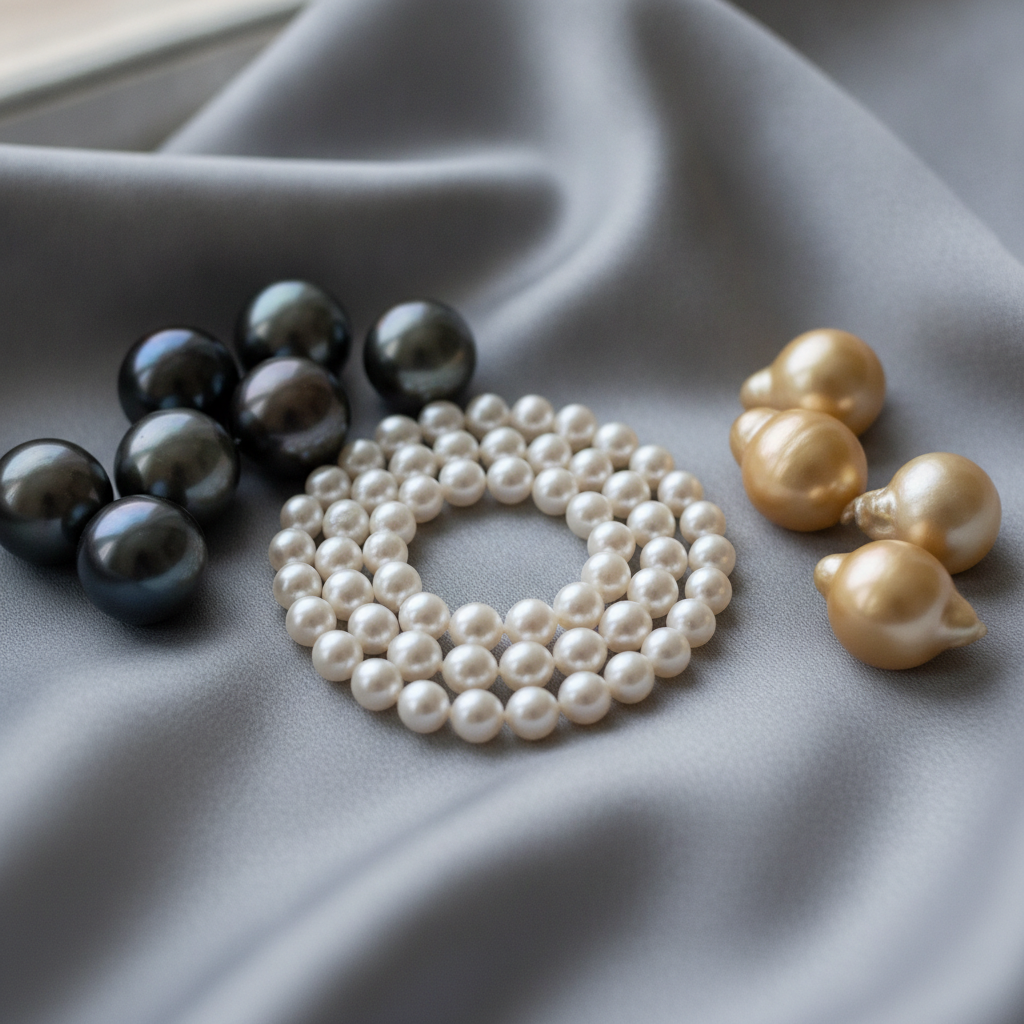
Akoya pearls, farmed primarily in Japan and China from small saltwater oysters, defined the classic pearl look: round, white to cream with rose or silver overtones, sharp mirror-like luster, in sizes typically from 5 to 9 millimeters. A well-matched Akoya strand is the archetypal wedding and heirloom necklace.
Freshwater pearls, farmed mostly in China from mussels, dominate today's affordable market. Historically off-round and softer in luster, modern freshwater production has closed the gap dramatically—top freshwater rounds now rival Akoya at lower prices. Sizes run wide, colors include natural white, peach, pink, and lavender, and one mussel can grow dozens of pearls, which is why freshwater strands can cost a tenth of saltwater equivalents.
Tahitian pearls, from black-lipped oysters in French Polynesia, are the "black pearls"—naturally dark with green, peacock, aubergine, or silver overtones, typically 8 to 14 millimeters. Their body color is natural, not dyed, and that distinction is a core value question when evaluating any dark pearl.
South Sea pearls, from Australia, Indonesia, and the Philippines, are the largest and most expensive category: white or golden, 9 to 17 millimeters and beyond, with a soft, satiny luster. Fine golden South Sea strands reach well into five figures.
Knowing the type frames every other judgment. A 12-millimeter round white pearl is either South Sea (valuable) or a large freshwater or imitation (not), and the luster character, weight, and drill-hole evidence separate them. When JewelValue reads your photos, type likelihood is the first thing worth establishing.
Real vs Fake: Tests That Actually Work
The classic first test costs nothing: the tooth test. Rub a pearl gently against the edge of a front tooth—real nacre (natural or cultured) feels slightly gritty, like fine sandpaper, while coated imitations feel glassy smooth. Rubbing two pearls against each other gives the same signal. It is a good screen, though not courtroom proof, and should be done gently on pearls you are allowed to touch.
Visual checks go further, and most work in good photos. Examine the drill holes: real pearls show layered nacre in cross-section at the hole, often with crisp edges, while imitations show coating that chips, flakes, or peels around the hole revealing glass or plastic underneath. Look at surface character under magnification: real pearls have subtle growth irregularities—tiny ridges, spots, dimples—while imitations are unnaturally uniform, sometimes with visible spray-coating texture or seams. Check matching across a strand: a strand of perfectly identical, flawless pearls is either extremely expensive or imitation, and price context tells you which.
Weight and temperature are secondary clues: glass imitations feel heavier than nacre and warm slowly; plastic feels light. Knots between pearls suggest someone valued the strand enough to string it properly, though imitations get knotted too. What none of these tests establish is natural versus cultured—that distinction requires X-ray examination at a gem lab, and it only matters economically when provenance suggests pre-1920s origin. For everyday questions—real nacre versus coated bead—the tooth test, drill holes, and surface character answer most cases, and JewelValue's photo analysis is built around exactly those visible signals.
How Pearls Are Graded and Valued
Pearl grading has no single universal system, but every serious dealer evaluates the same seven factors. Luster is king: the sharpness of reflections on the pearl's surface, from mirror-crisp (finest Akoya) to soft glow (South Sea) to chalky (low grade). Surface quality counts blemishes—spots, wrinkles, chips. Shape runs from perfectly round (most valuable in classic strands) through near-round, oval, button, drop, and baroque; note that dramatic baroque pearls have their own fashion-driven market. Size moves price steeply within each type. Color covers body color plus overtone, with rose-overtone whites and rich naturals commanding premiums. Nacre thickness determines durability and glow, and matching measures how uniformly a strand's pearls agree.
Some sellers use letter scales like A to AAA (common for freshwater and Akoya retail) or the Tahitian A–D system, but letters are not standardized between vendors—an "AAA" from one seller may equal another's "AA." Treat letter grades as within-seller shorthand and judge the pearls themselves, ideally against the factors above.
Realistic value ranges help calibrate expectations. Freshwater strands commonly run from under a hundred to several hundred dollars; good Akoya strands from several hundred into the low thousands; Tahitian strands from roughly a thousand upward; South Sea strands from a few thousand to well beyond. Vintage strands with thick nacre and surviving luster hold value; worn strands with chalky, peeling pearls are mostly sentimental. Clasps matter more than people expect—a gold clasp with maker's marks adds value and helps date the piece, as covered in our pearl necklace guide.
Treatments, Dyes, and What "Natural Color" Is Worth
Most pearls on the market are processed somewhere between harvest and store. Routine, accepted processing includes washing, gentle polishing, and bleaching (standard for Akoya) to even out color. More consequential treatments include dyeing—black "Tahitian-style" freshwater pearls, chocolate pearls, and vivid fashion colors—irradiation to darken, and luster coating on low-grade material.
Dye detection is often possible visually: dye concentrates in drill holes and surface pits, producing dark rings at the holes; color that looks flat and uniform without the shifting overtones of natural dark pearls; and colors nature does not produce in that pearl type. A "Tahitian" strand at a freshwater price is dyed freshwater—the price is the disclosure. Natural-color Tahitians and golden South Sea pearls carry premiums precisely because the color grew in the oyster, and reputable sellers state "natural color" explicitly.
Treatment status belongs in every buying decision and every listing you write as a seller. Undisclosed dye discovered later destroys buyer trust and transaction value. When you evaluate pearls with JewelValue, photograph drill holes and any pits closely—concentrated color at those points is the most photographable dye evidence, and the app's structured read helps you ask sellers the right questions before money moves.
Caring for Pearls So They Keep Their Value
Pearls are soft—2.5 to 4.5 on the Mohs scale—and organic, which makes care a value-preservation issue, not fussiness. The rule is "last on, first off": pearls go on after makeup, perfume, and hairspray, and come off before showering, swimming, or sleeping. Acids in cosmetics and even skin oils etch nacre over years; chlorine and prolonged water exposure weaken silk stringing and can cloud luster.
Clean pearls with a soft, slightly damp cloth after wear—never ultrasonic cleaners, never steam, never solvent dips. Store them flat in a soft pouch or cloth-lined box, separate from harder jewelry that will scratch them, and never in sealed plastic (nacre needs ambient humidity). Strands worn regularly should be restrung with fresh knotted silk every few years; stretched silk with gaps between knots is the warning sign, and a snapped unknotted strand loses pearls instantly.
Condition is value. A strand with intact luster, unchipped surfaces, and tight stringing sells and appraises entirely differently from the same pearls neglected. Document your pearls while they are healthy: photograph the strand, individual pearls, drill holes, and clasp, and keep a JewelValue scan with the record. That baseline serves insurance claims, future resale, and the family member who inherits the strand next.
Selling and Inheriting Pearls: A Practical Path
Inherited pearls generate more hopeful appraisal visits than almost any jewelry category, so a triage process saves everyone time. First, establish real versus imitation with the tooth test, drill-hole inspection, and a JewelValue photo scan—a large share of inherited "pearls" are mid-century costume imitations, and identifying them at home costs nothing. Second, for real pearls, establish the type and honest condition: luster survival matters more than age. Third, check the clasp for gold marks and maker signatures that add value and date the piece.
Escalate selectively. Strands that suggest quality—sharp luster, larger sizes, gold clasps, saltwater character—justify a professional appraisal, especially for insurance scheduling; our jewelry appraisal guide explains cost and process. The rare candidates for natural-pearl status (documented family provenance predating the 1920s, unusual shapes with period settings) merit gem-lab X-ray testing, because natural pearl strands trade at multiples of cultured equivalents.
When selling, match the venue to the goods: fine strands do best through jewelry-focused consignment or specialist buyers; mid-market cultured strands sell on marketplaces with honest photos and disclosed condition; imitation strands sell as vintage costume, where good design still finds buyers. In every case, organized documentation—type, measurements, condition photos, and a structured material read from Jewelry Identifier: JewelValue—moves the sale faster and defends your price.
Frequently Asked Questions
How can I tell if pearls are real or fake?
Rub a pearl gently against a front tooth: real nacre feels slightly gritty, imitations feel glassy smooth. Inspect drill holes for layered nacre versus chipped or peeling coating, and check surfaces under magnification—real pearls show subtle growth irregularities while imitations look uniformly perfect. A photo scan with JewelValue evaluates these visible signals; a gem lab can confirm difficult cases.
What are the main types of pearls?
Akoya (classic round white saltwater, sharp luster), freshwater (affordable, wide range of shapes and pastel colors), Tahitian (naturally dark with green and peacock overtones), and South Sea (largest and most expensive, white or golden). Natural pearls—formed without farming—are a separate rarity that requires X-ray testing to confirm and mostly matters for pre-1920s pieces.
How much are pearls worth?
Freshwater strands commonly run tens to hundreds of dollars; quality Akoya strands several hundred to a few thousand; Tahitian strands from about a thousand upward; South Sea strands from a few thousand to five figures. Luster, surface quality, size, shape, nacre thickness, matching, and natural color drive the price within each type, and condition can halve or preserve any of it.
Are cultured pearls real pearls?
Yes. Cultured pearls grow inside living mollusks and consist of the same nacre as natural pearls—farmers simply start the process with an implanted nucleus or tissue graft. Virtually all real pearls sold since the 1920s are cultured. Imitation "pearls" (coated glass, plastic, or shell beads) are not pearls at all, regardless of trade names.
Can JewelValue identify pearls from a photo?
JewelValue assesses luster character, surface quality, shape and matching, likely pearl type, and clasp metal from clear photographs, and flags signs of dye or imitation coating. It cannot X-ray for natural-versus-cultured origin—no photo tool can—but it answers the questions that decide most real-world cases and tells you when professional grading is worth the fee.
Download Jewelry Identifier: JewelValue Today
That strand in the jewelry box has an answer—Akoya or freshwater, natural color or dyed, heirloom or costume—and it starts with a photo. Jewelry Identifier: JewelValue reads luster, surface, shape, and clasp metal from your camera, estimates realistic value ranges, and tells you when a professional opinion is worth it.
Download Jewelry Identifier: JewelValue on the App Store and find out what your pearls really are today.