Few bracelets are copied as aggressively as the Van Cleef & Arpels Alhambra. The four-leaf clover motif has become one of the most recognizable silhouettes in fine jewelry, which means the secondary market is crowded with genuine pieces, licensed-look fashion jewelry, and outright counterfeits—often photographed side by side in the same marketplace search. Whether you inherited a clover bracelet, spotted one at an estate sale, or are considering a five-figure purchase from a reseller, knowing how to read construction, hallmarks, and materials protects you from expensive mistakes. This guide explains how Van Cleef bracelets are built, what authentication actually involves, and how Jewelry Identifier: JewelValue helps you run a structured first-pass evaluation from photographs. We have no affiliation with Van Cleef & Arpels; this is an independent identification resource.
Van Cleef & Arpels, founded in Paris in 1896, built its reputation on invisible-set gemstones, ballerina clips, and—since 1968—the Alhambra collection. An authentic Alhambra bracelet is a precision object: consistent motif dimensions, beaded edges with even spacing, and stone or mother-of-pearl inlays cut to fit their frames without visible glue or gaps. Counterfeits have improved dramatically, and some now include convincing boxes, certificates, and laser-etched serial numbers. That is exactly why a single "tell" is never enough; authentication is an accumulation of evidence across metal, motif, hallmarks, clasp, and provenance.
If you are starting with a bracelet in hand, photograph it systematically before anything else: full bracelet laid flat, each clasp side, every hallmark and serial under the best magnification you can manage, the reverse of each motif, and edge-on shots of the beading. JewelValue analyzes those photos for metal appearance, construction category, and likely materials, and gives you an organized starting point before you pay for professional authentication. For general technique, see our guide to identifying jewelry by photo.
The Alhambra Family: Styles and Sizes
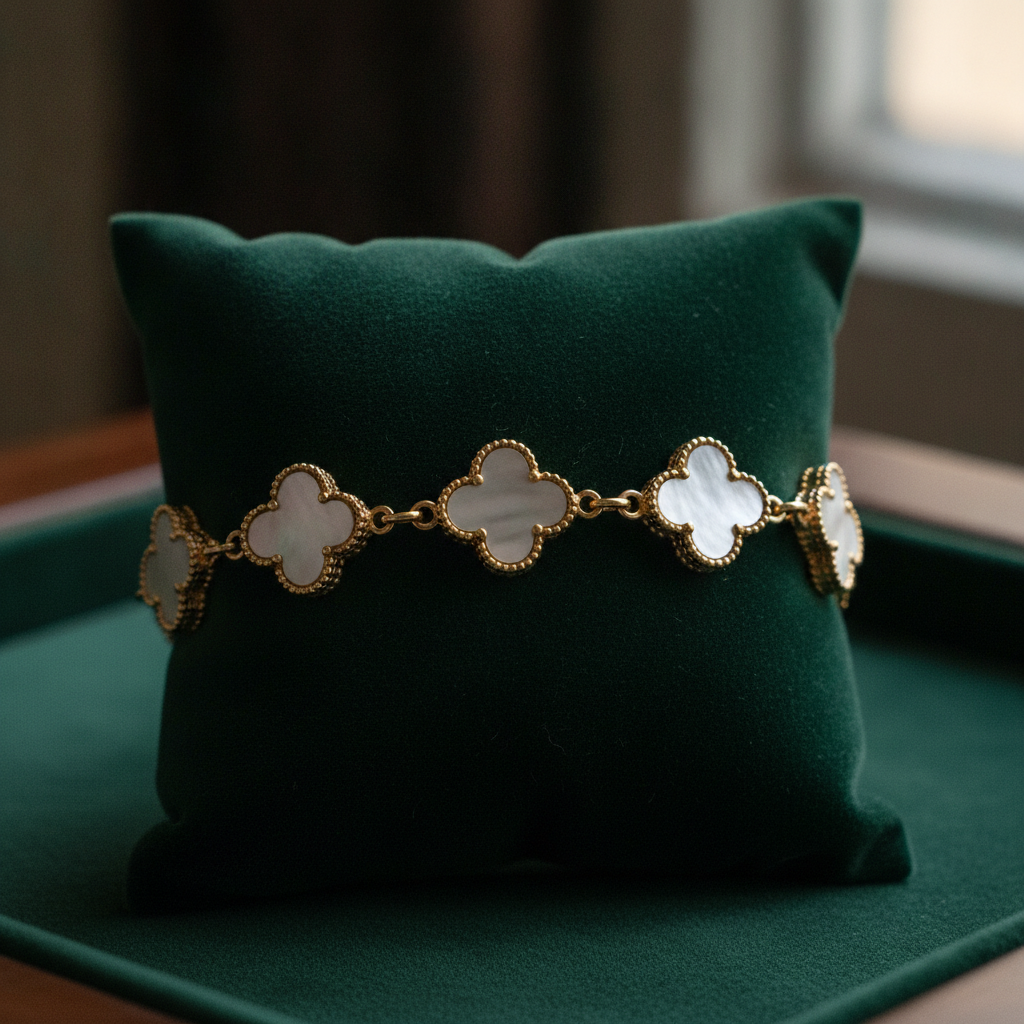
The Alhambra line spans several distinct bracelet formats, and knowing which one you are looking at is the first identification step. The Vintage Alhambra five-motif bracelet is the classic: five clover motifs of roughly 15 mm connected by chain, with beaded metal edging around each motif. The Sweet Alhambra scales the motif down to around 9 mm, usually with a single charm or six smaller motifs. The Magic Alhambra mixes motif sizes—some noticeably larger—on one asymmetric bracelet. The Pure Alhambra removes the beaded edge for a smooth outline, and the Lucky Alhambra mixes clovers with butterflies, hearts, and leaf shapes.
Material combinations matter for both identification and value. Common pairings include yellow gold with mother-of-pearl, onyx, carnelian, malachite, or tiger's eye; white gold with chalcedony or diamond pavé; and rose gold with pink porcelain-look or gray mother-of-pearl. Some combinations were produced only in limited runs or holiday editions, and a combination that Van Cleef never made is an immediate red flag. When you photograph a bracelet for evaluation, capture the stone surface in diffuse light: genuine mother-of-pearl shows layered iridescence that shifts with angle, while plastic imitations look uniformly milky.
Counterfeiters most often copy the five-motif Vintage Alhambra in yellow gold with white mother-of-pearl because it is the best-known configuration. If a listing shows that exact bracelet at a fraction of typical resale, treat the price itself as evidence. Genuine pre-owned five-motif bracelets typically hold strong resale value precisely because demand outstrips supply.
Hallmarks, Serial Numbers, and Stamps
Authentic Van Cleef bracelets carry a consistent set of marks, usually on the clasp tongue or an adjacent link plate: the VCA or Van Cleef & Arpels signature, a metal fineness mark such as 750 for 18k gold, a serial number unique to the piece, and often French assay marks like the eagle's head for gold. The engraving on genuine pieces is clean, evenly spaced, and precisely aligned; under magnification the letterforms have crisp edges rather than the fuzzy, acid-etched look common on fakes.
Serial numbers deserve special attention. A genuine serial is unique, so search the exact number—if the identical serial appears in multiple listings across the internet, you are almost certainly looking at a counterfeit template that has been reused. Be aware that a "correct-looking" serial proves little on its own, since counterfeiters copy real formats. Conversely, worn hallmarks on a heavily loved vintage bracelet do not automatically mean fake; decades of wrist wear can soften stamps.
Photograph every mark straight-on and at a raking angle so the engraving depth is visible. This is one of the highest-value photo sets you can feed into JewelValue, and it is exactly what a professional authenticator will ask to see first. Our jewelry appraisal guide explains how these preliminary checks fit into a formal appraisal when insurance or resale documentation is the goal.
Construction Details That Separate Genuine From Fake
Beyond stamps, construction quality is where genuine Van Cleef bracelets distinguish themselves. Study the beaded edge on Vintage Alhambra motifs: authentic beads are uniform hemispheres, evenly spaced, with no flat spots, casting pits, or solder blobs between them. Counterfeit beading frequently looks slightly irregular, with beads that vary in size or merge together at points.
Check the motif reverse. Genuine pieces finish the back nearly as carefully as the front—smooth surfaces, clean frames around the inlay, and no glue residue at stone margins. Inlays on authentic bracelets are cut to fit; you should not see gaps between the stone and its beaded frame or adhesive shine at the edges. The chain links between motifs are consistent in size and solder quality, and the clasp operates with a positive, precise action rather than a loose wobble.
Weight and dimensions are useful secondary checks. An 18k gold five-motif bracelet has a substantial, dense feel; a plated brass copy is often noticeably lighter, though some counterfeiters add weight deliberately. Motif diameter is standardized per line, so a "Vintage Alhambra" with 13 mm or 17 mm motifs is wrong. A magnet should produce no attraction on gold—any magnetic response indicates steel components, though a passed magnet test proves nothing by itself. These are exactly the material-versus-construction questions JewelValue helps you organize from photos before you decide whether professional authentication is worth the fee.
What Van Cleef Bracelets Cost: Retail and Resale
Van Cleef pricing sits firmly in the luxury tier and has risen repeatedly over the past decade. As a general orientation: Sweet Alhambra bracelets typically enter the range of a few thousand dollars; Vintage Alhambra five-motif bracelets in gold with stone inlay commonly retail in the low-to-mid five figures depending on material; diamond pavé and Magic Alhambra configurations climb well beyond. Exact prices vary by region and change with gold markets and brand adjustments, so always verify current retail directly.
The resale market is unusually strong. Clean, complete five-motif bracelets in popular combinations frequently resell at a high percentage of retail—and discontinued combinations like turquoise or lapis can exceed original retail among collectors. Condition drives the spread: crisp beading, unscratched inlay, unstretched chain, and original box and papers command premiums. Polished-out hallmarks, replaced clasps, or chipped mother-of-pearl cut value meaningfully.
For sellers, honest documentation is the fastest route to a fair price. Photograph condition flaws plainly, record the serial, and get a structured material read with JewelValue before listing—buyers of luxury pieces respond to organized evidence. For a broader look at how luxury brands hold value, see our luxury jewelry guide.
Buying Pre-Owned Safely
The pre-owned market is where most Van Cleef bracelet transactions happen, and it rewards process over trust. Buy from sellers who offer authentication guarantees and real return windows. Established resale platforms with in-house authentication teams remove much of the risk, at the cost of higher prices; private sales offer better numbers but put the burden of verification on you.
Insist on original, unedited photos—not catalog images—and specifically request the hallmark and serial shots described above. Video of the clasp operating and the bracelet moving in hand reveals more than static images. Ask for provenance: original receipt, service records from Van Cleef boutiques, or prior authentication documents. None of these are proof alone (paperwork is forged too), but coherent provenance plus correct construction plus correct marks builds a strong case.
For any purchase at real Van Cleef prices, plan a professional in-person authentication either before payment or within a return window. A jeweler experienced with the brand—or the boutique itself via a service request—can confirm what photos suggest. Use JewelValue as your first filter to walk away from obvious fakes early, and save professional fees for pieces that pass the photo stage.
Care, Wear, and Long-Term Value Protection
Alhambra bracelets are durable but not indestructible, and the inlay materials need specific care. Mother-of-pearl and porous stones like malachite or turquoise are vulnerable to perfumes, lotions, and household chemicals; put the bracelet on last when dressing and remove it before cleaning or swimming. Onyx and carnelian tolerate more but still scratch against harder surfaces. Store the bracelet flat in a soft pouch so motifs do not grind against other jewelry.
Chain stretch is the most common structural issue on worn bracelets. If the bracelet has visibly elongated links near the clasp or motifs that no longer sit flat, factor repair into value. Van Cleef offers servicing for genuine pieces—cleaning, link repair, clasp adjustment—and service receipts become part of the provenance chain that supports future resale.
Document your bracelet while it is in good condition: clear photos of every motif, hallmark, and the serial number, stored with your receipt and any papers. If you ever face an insurance claim, sale, or inheritance division, that record is invaluable. JewelValue makes this documentation habit easy—scan the piece once, keep the structured results, and update photos after any service or damage.
How JewelValue Fits Into Van Cleef Identification
A photo-based tool cannot issue brand authentication—no honest app can—but it can dramatically improve the quality of your first-pass evaluation. Point Jewelry Identifier: JewelValue at your photo set and it helps categorize metal appearance (yellow, rose, white), inlay material family (shell-like versus stone versus glass or plastic), construction style, and overall category, and frames sensible value context from visible characteristics.
That structure matters most in three situations. First, estate triage: when a jewelry box holds one possible Alhambra among dozens of fashion pieces, a fast photo scan tells you where to spend attention. Second, marketplace filtering: before you drive across town or wire money, a structured read on listing photos flags mismatched construction or suspicious inlay. Third, seller preparation: organized material notes plus honest condition photos produce listings that serious buyers trust.
Pair the app's output with the checks in this guide—hallmarks, serial search, beading quality, inlay fit—and escalate to professional authentication whenever real money is at stake. The combination of a careful photo process and expert confirmation is how experienced collectors avoid the counterfeit trap entirely. For related reading, our jewelry identifier app guide covers what photo identification can and cannot determine across brands.
Frequently Asked Questions
How can I tell if a Van Cleef bracelet is real?
Build a case from multiple checks: correct motif size and beading quality, clean inlay fit with no glue residue, crisp hallmarks (VCA signature, 750, serial, assay marks), a unique serial number that does not appear in other listings, correct weight and clasp action, and coherent provenance. No single test is sufficient. Use JewelValue for a structured photo-based first pass, then get professional authentication for any high-value purchase.
How much does a Van Cleef Alhambra bracelet cost?
Sweet Alhambra bracelets generally start around the low thousands, Vintage Alhambra five-motif bracelets in gold with stone inlay commonly retail in the low-to-mid five figures, and diamond pavé versions cost substantially more. Prices rise regularly and vary by region, so check current retail directly. Pre-owned prices track demand closely, and popular or discontinued combinations can resell near or above original retail.
Where are the hallmarks on a Van Cleef bracelet?
Most bracelets carry marks on or near the clasp: the brand signature, a gold fineness stamp such as 750, a unique serial number, and often French assay marks like the eagle's head. Marks should be crisply engraved and evenly aligned. Worn marks on vintage pieces are possible, but missing, misspelled, or fuzzy stamps are strong warnings.
Do Van Cleef bracelets hold their value?
Yes—Alhambra bracelets are among the strongest value holders in branded jewelry. Clean five-motif bracelets in demanded combinations frequently resell at a high percentage of retail, and some discontinued stone combinations appreciate. Condition, completeness (box and papers), and service history drive the final number.
Can JewelValue authenticate a Van Cleef bracelet?
No app can issue formal brand authentication. JewelValue analyzes photos to assess metal appearance, likely inlay material, construction category, and value context, which helps you filter obvious fakes, triage estate finds, and prepare organized documentation. For purchases or sales at genuine Van Cleef prices, combine the app's first pass with in-person authentication by the brand or an experienced luxury jewelry specialist.
Download Jewelry Identifier: JewelValue Today
Evaluating a clover-motif bracelet—or an entire jewelry box—starts with a single photo. Jewelry Identifier: JewelValue identifies metals, stones, and construction styles from your camera, estimates market value ranges, and tells you when a piece deserves professional authentication. Scan your bracelet today and know what you are really holding before you buy, sell, or insure.
Download Jewelry Identifier: JewelValue on the App Store and turn photographs into informed jewelry decisions.