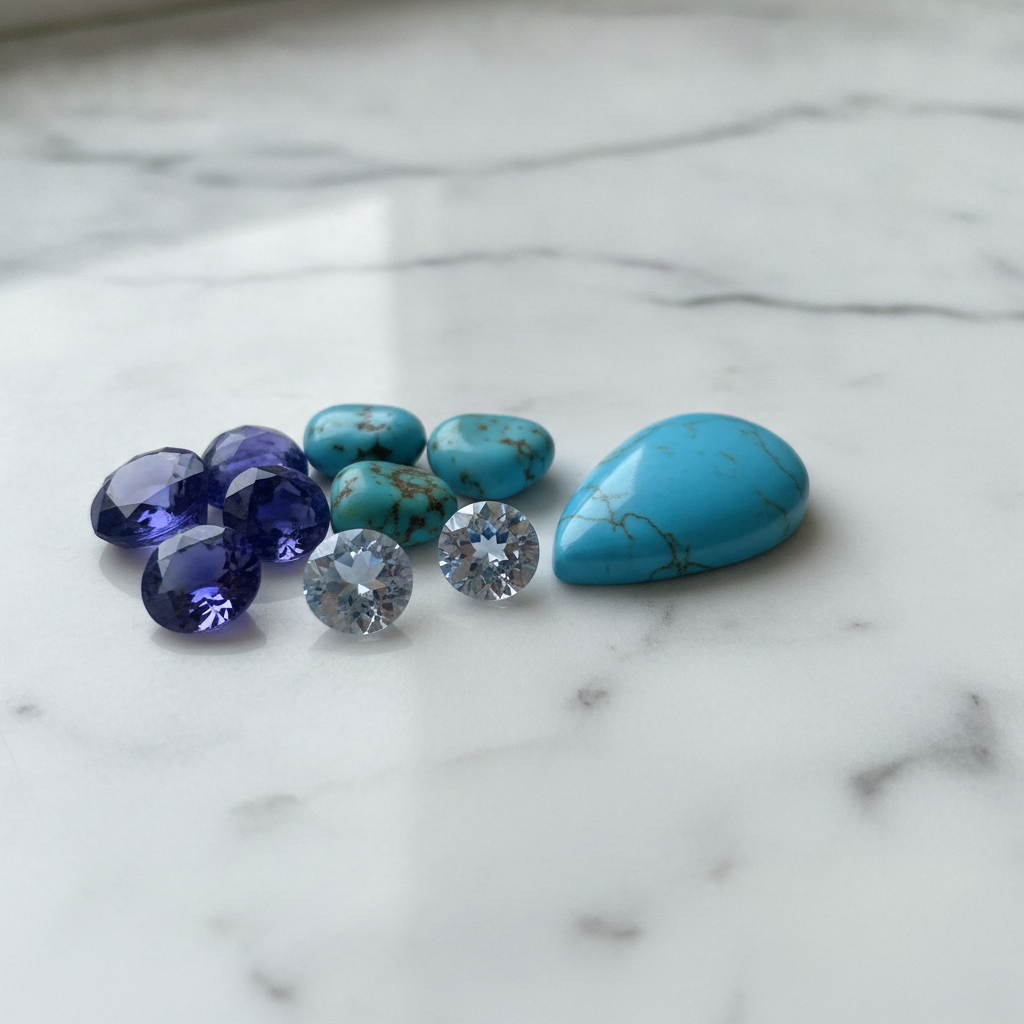
December birthstone jewelry is three different materials sold under one calendar square. Turquoise is opaque, porous, and usually treated. Tanzanite is a transparent blue-violet gem that did not exist in the jewelry trade before the late 1960s. Blue zircon is a natural stone with diamond-like fire that gets mistaken, constantly, for cubic zirconia. The month on a gift receipt does not tell you which of the three is in the setting, what was done to the color, or what a buyer will pay. This guide separates them the way a reseller has to: by what you can see, by the treatments that change price, and by the date line that makes some "antique tanzanite" claims impossible.
The modern commercial list used by American jewelers assigns December three stones: turquoise, tanzanite, and zircon. Turquoise is the traditional December stone. Tanzanite was added in 2002. Zircon, especially blue zircon, has been sold as a December alternate for much longer than tanzanite has existed. Older pieces follow older habits, so a Victorian December gift is far more likely to be turquoise, garnet, or a blue glass doublet than anything mined in Tanzania. The full calendar, including the other eleven months, is in our birthstones guide. December is worth its own page because the three stones fail in different ways, and the failures are expensive if you are buying or selling.
Jewelry Identifier: JewelValue is the first pass, not the last word. A clear photo of the stone, a side view, and any metal stamp will sort a large share of December jewelry into "opaque turquoise-like," "transparent blue with strong fire," or "transparent blue-violet," and that sort is already enough to stop a bad purchase at a flea market. Take anything with serious money attached to a gemologist after that.
Three Stones, One Birthday
People say "the December birthstone" as if it were a single gem. Retailers like the phrase because it lets them offer a $40 sterling ring and a $4,000 tanzanite ring as the same gift. For identification, the phrase is useless until you name the species.
Turquoise is a hydrated copper aluminum phosphate. It is opaque. It ranges from robin's-egg blue to greenish blue, often with brown, black, or golden matrix. It sits around 5 to 6 on the Mohs scale, so it scratches, and it is porous, so it drinks oil, perfume, and resin. Almost every commercial cabochon has been stabilized. Natural, untreated turquoise is the exception, and the price knows it.
Tanzanite is blue to violet zoisite from a single producing area around Merelani, Tanzania. It is transparent, strongly pleochroic — blue from one direction, violet or brownish from another — and relatively fragile for a gem of its fame, with a hardness near 6.5 to 7 and easy cleavage. Heat turns the brownish rough into the blue-violet color the public expects. That heat is standard, stable, and already assumed in the price of a normal stone.
Zircon is zirconium silicate, a natural mineral. Cubic zirconia is a lab-grown zirconium oxide made to imitate diamond. They share a word and nothing else about value. Blue zircon is usually brownish zircon that has been heated. It is transparent, highly dispersive, and so birefringent that a 10x loupe shows doubled facet junctions. That doubling is the field test. Jewelers have used zircon, including colorless zircon, as a diamond stand-in for generations. As a December stone it is the affordable transparent option, and it is the one most often mislabeled in estate boxes.
Turquoise: Matrix, Mines, and Treatments
Start with the matrix, the web of host rock in the blue. Fine natural Persian turquoise from the Nishapur region of Iran is famous for a tight black spiderweb and an even blue. American stones are a different map. Sleeping Beauty, near Globe, Arizona, became the reference for even, matrix-free robin's-egg blue; that mine closed in 2012, so "new Sleeping Beauty" is old stock or a color nickname. Kingman, Arizona, is often bluer with matrix. Bisbee, Arizona, closed in the 1970s, and natural Bisbee with the right color and matrix is a collector material, not a mall-jewelry material. Chinese, Tibetan, and Egyptian (Sinai) turquoise supply a large share of what is cut today. Origin claims on a tag are marketing until someone can support them. Color, treatment, and whether the stone is one piece of turquoise are the facts that change a price today.
Treatment is the center of turquoise identification. Stabilized turquoise has been impregnated with resin so the chalky, porous rough will take a polish and hold together in a ring. Most turquoise in ordinary jewelry stores is stabilized. The color can still be natural; the durability is assisted. Stabilized material is legitimate when it is disclosed. It is worth less than an equivalent untreated stone, often by a wide margin.
Dyed turquoise starts as pale or chalky material and is colored blue. Dye can pool in cracks and look too even, like paint. Reconstituted turquoise is ground turquoise, or sometimes ground lookalike minerals, pressed with a binder into a block and cut. The matrix on reconstituted blocks often looks printed: repeating, floating, or strangely uniform from cabochon to cabochon. Block turquoise sold by the slice at craft prices is usually this category.
Lookalikes do not contain turquoise at all. Howlite and magnesite take blue dye and are the usual stand-ins in inexpensive fashion jewelry. Plastic and glass show up in souvenir pieces. A doublet or triplet uses a thin slice of turquoise, or a slice of something blue, over a backing, sometimes with a clear cap. If the blue layer is paper-thin at the edge of the cabochon, you are looking at an assembled stone.
A practical field check, short of a lab: turquoise is opaque and slightly waxy. Dyed howlite often shows dye in fine cracks and a gray-white body where a chip reaches unstained material. Plastic feels warm and light and may show a mold line. None of these home observations replace a gemologist when the ask is high. They are enough to walk away from a "natural Persian" ring that looks like dyed howlite in a plated setting.
Metal matters as much as the stone on resale. Southwestern-style silver with natural or well-disclosed stabilized turquoise has a buyer. The same blue cabochon in unmarked pot metal does not. Read the stamp — sterling, 925, coin, or a karat mark — using the method in our gold jewelry identification guide. A December birthstone ring with no stamp and a greenish skin stain under the band is telling you about the metal before you ever test the stone.
Tanzanite and the 1967 Line
Tanzanite has a hard historical edge, which is rare in gemstones and useful in estate work. The deposit at Merelani was found in 1967. Tiffany introduced the name tanzanite in 1968. A brooch with a Victorian catch, a mourning compartment, or a clearly nineteenth-century mount cannot contain tanzanite unless the stone was added later. When a seller calls a blue stone in an Art Nouveau setting "antique tanzanite," the stone is something else, or the setting has been rebuilt around a modern gem. Both happen. Our antique jewelry identification guide is the partner skill: date the mount first, then ask whether the stone could have been available.
Color is judged by how close the stone comes to a saturated blue-violet with little brown or gray when you look down through the table. Tanzanite is strongly pleochroic, so the cutter orients the blue direction toward the face. Tip the stone and you may see violet or a muddy tone. That shift is a feature of the species, and it is one way to separate tanzanite from blue sapphire, which does not flash that way, and from blue glass, which has no pleochroism at all.
Heat treatment is assumed. Unheated tanzanite of fine blue color exists and brings a premium when a lab confirms it. You will not establish that at a kitchen table. What you can establish is the common fraud: simulants. The one that fools phone photos is synthetic forsterite, sold specifically because it can look like tanzanite. Blue synthetic sapphire, cubic zirconia, and glass fill out the cheaper fakes. Tanzanite's pleochroism and its moderate doubling under magnification, combined with a refractive index a jeweler can read, sort these. A photo gets you into the right suspicion. A refractometer closes it.
Size and color move the price more than the month it is assigned to. Commercial jewelry often uses small tanzanite accents that are pretty and inexpensive. A well-cut stone of several carats in a strong blue-violet is a different object, and it deserves a written disclosure of treatment plus a careful look at the setting. Tanzanite chips. Open prongs and thin girdles are how estate stones lose corners in a drawer.
Because there is one commercial source region, supply stories show up in sales pitches every few years. Treat "they are closing the mine" as a reason to check the stone in front of you, not as a reason to skip the check. The identification problem does not change when the story gets urgent.
Blue Zircon, the Stone People Confuse with Cubic Zirconia
Say the full name. Blue zircon is a natural gemstone. Cubic zirconia is a diamond simulant invented for the trade in the twentieth century. Estate listings mash them together because both get abbreviated to "CZ," which is unfair to zircon and confusing to buyers. If a December birthstone listing says CZ, ask which material they mean and ask for a photo through the side of the stone. Zircon has heft, adamantine luster, and obvious facet doubling. Cubic zirconia is singly refractive, so the facet junctions stay single under a loupe.
Zircon's birefringence is high enough that doubling is a loupe test, not a lab test. Look at the pavilion facets through the table with 10x. If the back edges look like two edges slightly offset, you are in zircon territory (or another strongly birefringent species), and you are not looking at diamond, glass, or cubic zirconia. Blue sapphire can show a little doubling and will not show zircon's fiery dispersion. Tanzanite's doubling is milder. This is the comparison that earns its keep at a pawn counter when three blue stones are in one tray.
Most blue zircon on the market was heated to produce that color from brown, reddish, or yellowish rough. The trade treats heated blue as normal. In ordinary wear the color stays put. High heat is the enemy — a jeweler's torch on a repair, not a day of sunlight — so tell anyone who sizes the ring that the stone is zircon before they work next to it. Some stones are brittle at the facet edges. Old zircon often shows "paper wear," a soft abrasion along the edges that diamond does not develop as quickly. Wear is a clue, not damage you should hide if you are selling honestly. Collectors of antique jewelry would rather see honest wear than a freshly polished mystery.
Colorless zircon in Georgian and Victorian jewelry was a deliberate diamond substitute, often in silver-topped settings. If you inherit a sparkly old cluster and someone calls it "paste or CZ," check for doubling before you accept paste prices. Paste is glass. It is common, and it is usually worth the setting more than the stones. Zircon is a different resale conversation. Our vintage jewelry appraisal guide covers how to separate period settings from the stones sitting in them.
How to Tell December's Stones Apart
Use daylight or a neutral lamp. Case spots and phone flash flatten turquoise and exaggerate zircon's fire.
| What you see | Turquoise | Tanzanite | Blue zircon |
|---|---|---|---|
| Transparency | Opaque, waxy | Transparent | Transparent, fiery |
| Matrix or web | Common on natural and on reconstituted | None | None |
| Pleochroism | None | Strong; color shifts as you tip it | Weak compared with its fire |
| Facet doubling at 10x | Not faceted in normal cuts | Mild | Strong and obvious |
| Typical cut | Cabochon | Faceted | Faceted |
| Hard historical limit | Used for centuries | Not available before 1967 | Used for centuries; commercial blue is mostly heated |
| Common stand-in | Dyed howlite, plastic, reconstituted block | Synthetic forsterite, glass, blue sapphire | Cubic zirconia, glass, confused labeling |
Photograph the face, the side or girdle, and the back of the setting. Turquoise that is a thin cap over a dark base shows itself from the side. Zircon's doubling sometimes shows in a sharp macro photo of the pavilion. Stamps inside the band date the mount and tell you whether the metal is worth more than the stone, which is often true for small zircon and stabilized turquoise and often false for fine tanzanite.
JewelValue reads those photos for a likely stone family and a value range you can use as a sorting tool. Bring the same photos to a jeweler when the range, or the ask, is high enough that being wrong would hurt.
What December Birthstone Jewelry Actually Brings
These are retail-context ranges for intact, honestly described pieces in ordinary condition. They are a way to decide whether you need a gemologist, a scrap buyer, or neither. They are not appraisals, and local sold prices move with color, size, treatment, and whether the metal is stamped.
| Piece | Typical retail context |
|---|---|
| Dyed howlite or plastic "turquoise" fashion ring | Under $30 |
| Stabilized turquoise cabochon in stamped sterling | $40–200 |
| Natural untreated turquoise, modest cabochon, good color, signed or well-made silver | $200–1,000 |
| Fine natural spiderweb or documented Bisbee, larger or matched | $1,000 and up, sometimes far up |
| Tanzanite accent under half a carat, commercial color, in sterling or 10k | $75–300 for the piece |
| Tanzanite around 1–2 carats, attractive blue-violet, in 14k | Several hundred to about $2,000 |
| Fine tanzanite of several carats, strong color, quality cut | Several thousand and higher |
| Commercial blue zircon in silver or 10k | $40–250 |
| Larger well-cut blue zircon in 14k or 18k | $200–800 |
Two patterns show up over and over in estate boxes. First, the metal floor can exceed the stone. A heavy 14k band with a small, included blue zircon is a gold purchase. Price it as gold, then decide whether the stone adds anything. Second, treatment silence is where turquoise money disappears. A buyer who pays natural prices for stabilized or reconstituted material does not get that money back. If the seller cannot say "stabilized," "natural," or "reconstituted," price it as the weakest of those until you know more.
Tanzanite is the December stone most likely to justify a written gem identification when the stone is over a carat and the color is obviously fine. Zircon rarely does, unless the stone is large, the setting is period, or someone has priced it as sapphire. Turquoise justifies a specialist when the claim is natural Persian, natural Bisbee, or a known artist's silverwork. The rest can be bought and sold on disclosure, stamps, and condition.
Buying, Inheriting, and Selling December Jewelry
At a retail counter, ask for the species and the treatment in words you can write down. "Natural turquoise, stabilized" is a clear phrase. "Genuine December birthstone" is not. "Tanzanite" should mean zoisite, and the receipt should say so if you are paying tanzanite money. "Blue zircon" should be spelled out so a later reader does not convert it into cubic zirconia or into sapphire.
Inherited pieces need a slower order of operations. Photograph the piece before you clean it. Cleaning is how turquoise loses dye evidence and how a soft zircon loses a bruised edge you meant to disclose. Date the mount: a 1960s cocktail ring can hold tanzanite; a 1910 ring cannot, unless it was reset. Then identify the stone family. Then decide the path — wear it, insure it, or sell it. Insurance replacement and resale are different numbers. The appraisal guide explains when the formal document is the right tool; a photo scan is the right tool for sorting a jewelry box before you pay for that document.
Selling has a matching discipline. Name the treatment you know. If you do not know, say so. Stabilized turquoise with an honest label sells. The same stone sold as untreated Persian damages the next sale and, often, comes back. Include the gram weight and karat for gold settings so a buyer can see the floor. Pawn offers on small blue stones cluster near the metal. Estate dealers pay more when the stone is identifiable and the setting is intact, including the original box only when the box matches the piece.
Holiday marketing leans on December harder than on most months. The stone in a "December birthday" pendant at a chain may be stabilized turquoise, blue topaz, blue zircon, or a simulant, depending on the year and the price point. The calendar is the advertising. The invoice is the identification.
Care That Matches the Material
Turquoise wants mild treatment. Keep it away from perfume, hairspray, lotion, and hot water. Those are how stabilized stones discolor at the edges and how natural stones absorb oil and turn greenish. Wipe with a soft dry cloth. Do not use ultrasonic cleaners, steam, or chemical dips. Store turquoise where harder gems cannot scratch it. A diamond band in the same compartment will win.
Tanzanite wants a setting that protects the girdle, and it wants no sudden knocks. Ultrasonic cleaners are a poor idea because of cleavage. Warm water and a soft brush are enough. Take the ring off for gym work and for anything that bangs the hand.
Zircon wants the same caution around heat and hard blows. Tell a repair jeweler the stone is zircon before sizing so the torch stays off the pavilion. Clean it the mild way. If facet edges are already worn, polishing is a decision about value: on a commercial modern ring it may freshen the look; on a period piece, original wear can be part of the object.
Across all three, the metal care is ordinary. Rhodium-plated white gold will yellow as plating wears. Sterling will tarnish and can be polished, carefully, away from the turquoise. None of that changes the species of the stone. It does change what a buyer sees in a photo, so photograph after a gentle clean and keep the earlier photo if you removed something that mattered.
Frequently Asked Questions
What is the December birthstone?
American jewelers treat three stones as December birthstones: turquoise, tanzanite, and zircon. Turquoise is the traditional choice. Tanzanite joined the commercial list in 2002. Blue zircon is the usual form of zircon sold for the month. A piece marked only "December" still has to be identified as one of these, or as a lookalike.
How can I tell turquoise from dyed howlite?
Turquoise is opaque and waxy, and natural or stabilized stones often show real matrix that continues around the curve of the cabochon. Dyed howlite is a white-to-gray mineral colored blue; dye gathers in cracks, and a chip may reveal a pale interior. Plastic imitations feel light and may show molding marks. Reconstituted "turquoise" has a repetitive matrix that looks assembled. High prices call for a gemologist either way.
Can an antique ring contain tanzanite?
Only if the stone was set after 1967. Tanzanite comes from a deposit found that year and was named in the trade in 1968. A genuinely Victorian or Art Nouveau mount with its original stones holds something else: sapphire, glass, zircon, or another blue material of the period. A tanzanite in an old mount is a later replacement, which is common and should be priced as a later replacement.
Is blue zircon the same as cubic zirconia?
No. Blue zircon is natural zirconium silicate, a real gemstone with strong fire and doubled facets under a loupe. Cubic zirconia is a synthetic diamond simulant. The shared abbreviation "CZ" causes the mix-up in listings. Ask sellers to spell the name, and check for facet doubling before you accept either a diamond price or a costume-jewelry price.
Does stabilized turquoise have resale value?
Yes, within a modest range, when the metal is real and the treatment is disclosed. Stabilized turquoise in stamped sterling is everyday gift jewelry, often in the tens to low hundreds of dollars. It does not bring natural Persian or Bisbee prices. Undisclosed stabilization is the expensive mistake. Natural, untreated stones of fine color are the ones that justify a specialist.
Download Jewelry Identifier: JewelValue Today
December birthstone pieces reward a slower look: which of the three stones you have, whether the turquoise was stabilized, and whether a blue sparkle is zircon, tanzanite, or a simulant. Jewelry Identifier: JewelValue identifies the metal and the likely stone family from a photograph, estimates a realistic value range, and gives you a record before you buy, sell, or insure.