Birthstones are the entry point into gemstones for most people—the first ring received at a graduation, the pendant marking a child's birth month, the pair of earrings in a grandmother's jewelry box with a stone nobody can name anymore. That personal connection is exactly why birthstone jewelry is worth identifying properly: the same amethyst-colored stone might be a natural gem, a lab-created equivalent, or a five-cent piece of glass, and the setting around it might be solid gold or plated brass. This guide walks through every month's stone, explains the difference between natural, lab-created, and simulated birthstones, and shows how Jewelry Identifier: JewelValue helps you evaluate birthstone jewelry from a photograph before you buy, sell, or simply satisfy your curiosity.
The modern birthstone list was standardized by the American National Retail Jewelers Association in 1912 and has been adjusted a few times since—most notably adding alexandrite, tanzanite, and spinel as alternates. Older jewelry may follow earlier traditions, so a Victorian December ring might hold turquoise where a modern one holds tanzanite or blue zircon. Knowing both the current list and its history helps when dating inherited pieces, a skill that pairs naturally with the techniques in our antique jewelry identification guide.
Identification always starts the same way: good photographs. Capture the stone face-up in daylight, from the side showing its depth, and close enough to see how it is set. Add a shot of any metal stamps inside the band or on the clasp. JewelValue reads those images for likely stone family, metal appearance, and construction quality, giving you a structured starting point in seconds rather than guesswork.
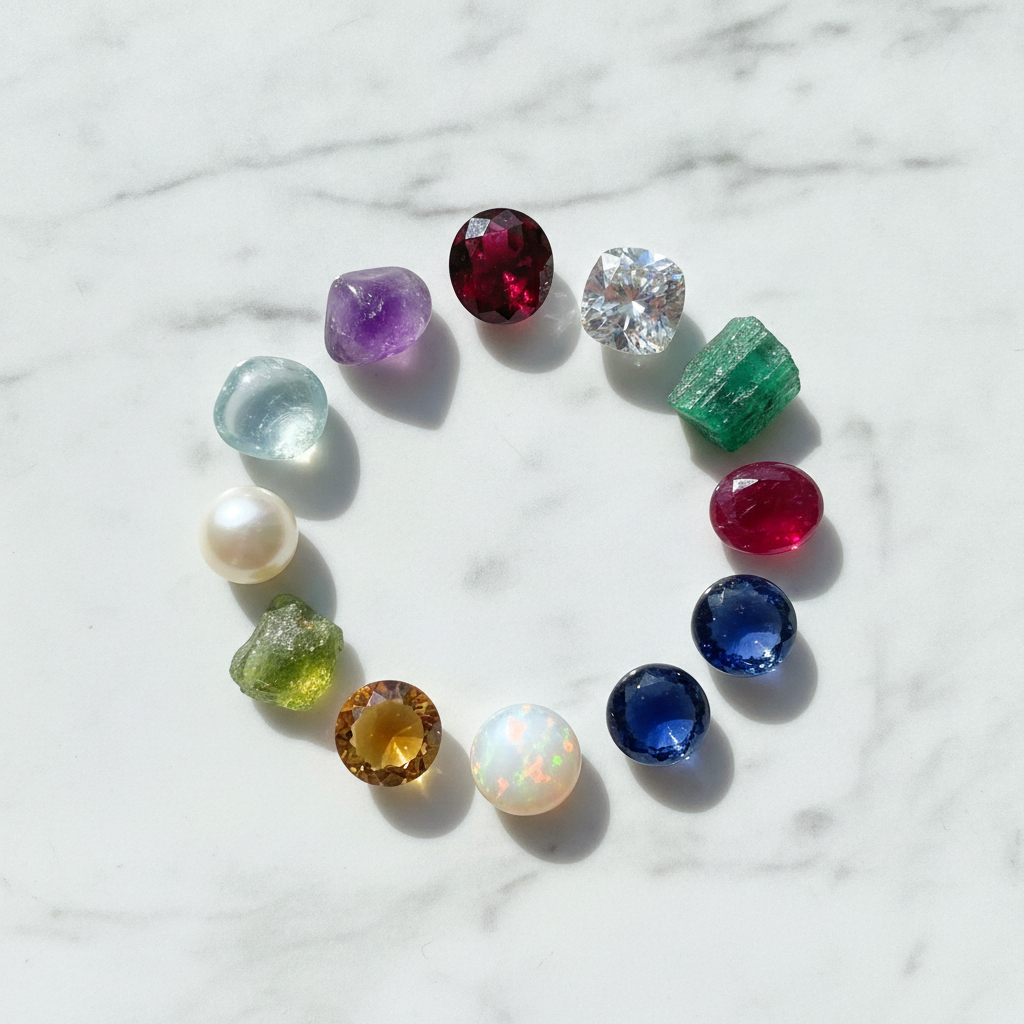
Birthstones by Month: The Complete List
January — Garnet. Most commonly deep red, though garnets span green (tsavorite), orange (spessartine), and purplish hues. Affordable in commercial sizes and rarely treated, garnet is one of the most honest stones in inexpensive jewelry.
February — Amethyst. Purple quartz, from pale lilac to deep Siberian violet. Abundant and affordable natural material means simulants are less common, but lab-grown amethyst exists and is nearly indistinguishable without lab testing.
March — Aquamarine (traditional alternate: bloodstone). Light blue to blue-green beryl, the same mineral family as emerald. Pale commercial aquamarine is affordable; intense blue in larger sizes climbs steeply. Blue glass and synthetic spinel are the usual imposters in older jewelry.
April — Diamond. The month with the biggest identification stakes. Natural, lab-grown, moissanite, and cubic zirconia all appear in April jewelry, at wildly different values—our moissanite identification guide covers separating them.
May — Emerald. Green beryl, almost always included and almost always treated with oil or resin. Small bright emeralds in vintage settings are frequently simulated with green glass or doublets, making photo evaluation genuinely useful.
June — Pearl, alexandrite, and moonstone. Pearls dominate June jewelry; see our pearl necklace guide for cultured-versus-imitation checks. Natural alexandrite with a strong color change is among the rarest gems on the entire list—treat any affordable "alexandrite" as lab-grown or simulated until proven otherwise.
July — Ruby. Red corundum. Lead-glass-filled composite rubies flooded the market in recent decades and look convincing in photos while being worth a small fraction of untreated stones—a critical distinction for inherited "ruby" rings.
August — Peridot (alternates: spinel, sardonyx). Yellow-green and distinctive; peridot's oily green is hard to fake convincingly, making it one of the easier identifications.
September — Sapphire. Blue corundum, though sapphires come in nearly every color. Synthetic sapphire has been mass-produced since the early 1900s, so vintage does not mean natural—many mid-century class rings and birthstone pieces hold lab-grown corundum.
October — Opal and tourmaline. Opal's play-of-color is distinctive but imitated by foil-backed glass and synthetic opal with overly regular color patches. Tourmaline, especially pink, is the modern alternate.
November — Topaz and citrine. Most "November gold" stones in commercial jewelry are citrine (yellow quartz) or irradiated blue topaz. Both are affordable; precious imperial topaz is another tier entirely.
December — Turquoise, tanzanite, and blue zircon. Turquoise is heavily stabilized, dyed, or outright simulated in commercial jewelry; tanzanite is a modern addition found almost exclusively in post-1970s pieces—useful for dating.
Natural, Lab-Created, and Simulated: What the Words Mean
These three terms decide most of a birthstone's value, and sellers blur them constantly. A natural stone formed in the earth and was mined. A lab-created (synthetic) stone has the same chemical composition and crystal structure as the natural gem—real ruby, real sapphire, real emerald—but grew in a laboratory, typically at a small fraction of natural prices. A simulant merely looks like the gem: colored glass, cubic zirconia, synthetic spinel, or a cheaper natural stone standing in for a costlier one.
Commercial birthstone jewelry—mall-store mother's rings, birthstone pendants, class rings—overwhelmingly uses lab-created stones and simulants. That is not a scandal; it is how a five-stone mother's ring retails for $150. The problem arises at resale and inheritance, when memories inflate expectations. A "ruby" birthstone ring from 1985 is far more likely to hold synthetic corundum or red glass than a natural Burmese ruby, and the setting's gold content may exceed the stone's value.
Photo evaluation helps sort possibilities before lab work. Perfectly clean, vividly saturated stones at commercial price points suggest lab origin; bubbles visible inside the stone suggest glass; wear patterns matter too, since glass abrades and loses facet sharpness while corundum stays crisp for decades. JewelValue weighs these visible characteristics and tells you whether a stone merits gemological testing—the same triage professional buyers run by eye.
Reading the Setting: Metal Tells You Half the Story
The mount around a birthstone often determines most of the piece's value, and it is easier to verify than the stone. Check inside bands and on clasp tongues for stamps: 10k, 14k, 18k (or 417, 585, 750) for gold; 925 or Sterling for silver; marks like "GF," "1/20 12k GF," or "RGP" indicating gold-filled or rolled gold plate rather than solid metal. Class rings and mother's rings are commonly 10k gold—lower purity, but real and meltable. Our gold jewelry identification guide covers these marks in depth.
Setting style also dates and grades a piece. Machine-set commercial jewelry shows uniform prongs and casting seams; handmade or older settings show individual finishing. Foil-backed closed settings—where you cannot see the stone's pavilion—were standard in antique jewelry but in modern pieces often hide glass. A birthstone in a closed-back setting deserves extra skepticism about the stone and extra care in cleaning, since moisture ruins foil backing.
Weigh the whole piece mentally: a 10k mother's ring with five small synthetic stones is worth its gold weight plus modest style value; the same design in 18k with natural stones is a different object entirely. Photograph stamps alongside the stone shots—JewelValue uses both to frame the value conversation correctly.
Buying Birthstone Jewelry Without Overpaying
Birthstone jewelry pricing spans three orders of magnitude for the same look, so the buying skill is matching price to what the piece actually is. For gift-tier jewelry under a few hundred dollars, lab-created stones in solid silver or 10k gold are the honest sweet spot—durable, genuinely attractive, and fairly priced. Insist that listings state the stone origin explicitly; "created sapphire" and "genuine sapphire" are different products, and vague wording like "sapphire-color" means simulant.
For fine-jewelry purchases—natural stones of meaningful size—documentation becomes essential. Natural rubies, sapphires, emeralds, and alexandrite above roughly a carat should come with a gemological report from a recognized lab for any significant price, since treatments (heat, oiling, glass filling, diffusion) move values dramatically. A reputable independent jeweler will disclose treatments unprompted; evasiveness about treatment is itself an answer.
Secondhand and estate buying offers the best value if you can evaluate what you see. Run listing photos through JewelValue before bidding: a structured read on stone family, setting metal, and construction flags the listings worth pursuing and the "gold ruby ring" listings that are neither. Then confirm meaningful purchases in person or through platforms with return windows, following the same process discipline we describe in our jewelry appraisal guide.
Caring for Each Stone: Hardness and Hazards
Birthstones vary enormously in durability, and care mistakes destroy value faster than any marketplace scam. Diamond, ruby, and sapphire (Mohs 9–10) tolerate daily wear and ultrasonic cleaning when untreated. Quartz stones—amethyst, citrine—are fine at 7 but scratch over years of pocket-and-keys contact. Emerald is hard (7.5–8) yet fracture-prone and oil-treated: never ultrasonic-clean an emerald, never expose it to solvents.
The fragile end of the list needs real caution. Opal contains water and can craze in dry heat; turquoise is porous and absorbs skin oils and cosmetics; pearls (2.5–4.5) scratch against everything and dissolve in acid—perfume and hairspray are their enemies. Moonstone and tanzanite cleave under sharp impacts. For all of these: warm soapy water, a soft cloth, and separate storage in soft pouches rather than a jumbled box.
Condition affects identification too. A "sapphire" with heavily abraded facets probably is not sapphire, since corundum resists wear that destroys glass. When you photograph inherited pieces for JewelValue, include close-ups of facet edges and any chips—wear evidence is identification evidence.
Birthstone Jewelry as Heirloom: Documentation and Value
Because birthstone jewelry is tied to people and dates, it becomes heirloom material almost by default—and heirlooms create identification debt for the next generation. The kindest thing you can do for your heirs (and the smartest for insurance) is document pieces while their stories are known: photograph each piece thoroughly, record who wore it and when it was acquired, scan it with Jewelry Identifier: JewelValue for a material and value baseline, and keep receipts or appraisals together.
For inherited boxes arriving without documentation, triage systematically. Sort by apparent metal first using stamps, then scan each piece by photo to separate fine jewelry from costume. Expect the realistic distribution: most commercial birthstone jewelry carries modest value, a few pieces surprise on the upside (solid gold settings, natural stones, signed makers), and sentimental value follows its own economy entirely. Pieces flagged as potentially valuable deserve the professional-appraisal step; the rest deserve honest enjoyment.
Values worth knowing at the top end: natural alexandrite with strong color change, untreated rubies and sapphires with lab reports, fine natural pearls, and top-color aquamarine and imperial topaz can each reach into the thousands per carat. The odds any given inherited piece holds one are low—but nonzero, which is exactly why a two-minute photo scan is always worth it before anything heads to a garage sale.
Frequently Asked Questions
What are the birthstones for each month?
January garnet, February amethyst, March aquamarine, April diamond, May emerald, June pearl (or alexandrite/moonstone), July ruby, August peridot (or spinel), September sapphire, October opal (or tourmaline), November topaz (or citrine), December turquoise (or tanzanite/blue zircon). Older jewelry may follow earlier lists—useful for dating inherited pieces.
How can I tell if a birthstone is real?
Combine clues: natural stones usually show small inclusions while glass shows bubbles and worn facet edges; vivid flawless stones at low prices suggest lab-created origin; closed-back settings may hide foil-backed glass. Check the metal stamps too, since setting quality predicts stone quality. A photo scan with JewelValue narrows the possibilities, and a gemologist can confirm stones where real money is involved.
Are lab-created birthstones worth anything?
Lab-created rubies, sapphires, and emeralds are chemically real gems and make durable, attractive jewelry, but they carry a small fraction of natural-stone value and minimal resale premium. In commercial birthstone jewelry, the setting's gold or silver content often exceeds the lab stone's value. Their honest role is beauty per dollar, not investment.
Which birthstones need special care?
Opal, turquoise, and pearl top the caution list: no ultrasonic cleaners, no perfume or hairspray contact, no prolonged heat or dryness, storage in soft separate pouches. Emerald should never meet solvents or ultrasonic cleaning because of its standard oil treatment. Diamond, ruby, and sapphire tolerate daily wear best.
Can JewelValue identify birthstone jewelry from a photo?
Yes—photograph the stone face-up and in profile plus any metal stamps, and JewelValue assesses the likely stone family, metal, construction quality, and realistic value context. It flags which pieces merit professional gemological testing, which is exactly the triage an inherited jewelry box or marketplace listing needs before decisions get made.
Download Jewelry Identifier: JewelValue Today
Every birthstone piece has two stories: the person it commemorates and the materials it is actually made of. Jewelry Identifier: JewelValue tells you the second one from a photo—stone family, metal, construction, and value range—so you can buy confidently, sell honestly, and pass heirlooms down with their facts attached.
Download Jewelry Identifier: JewelValue on the App Store and identify your birthstone jewelry today.